
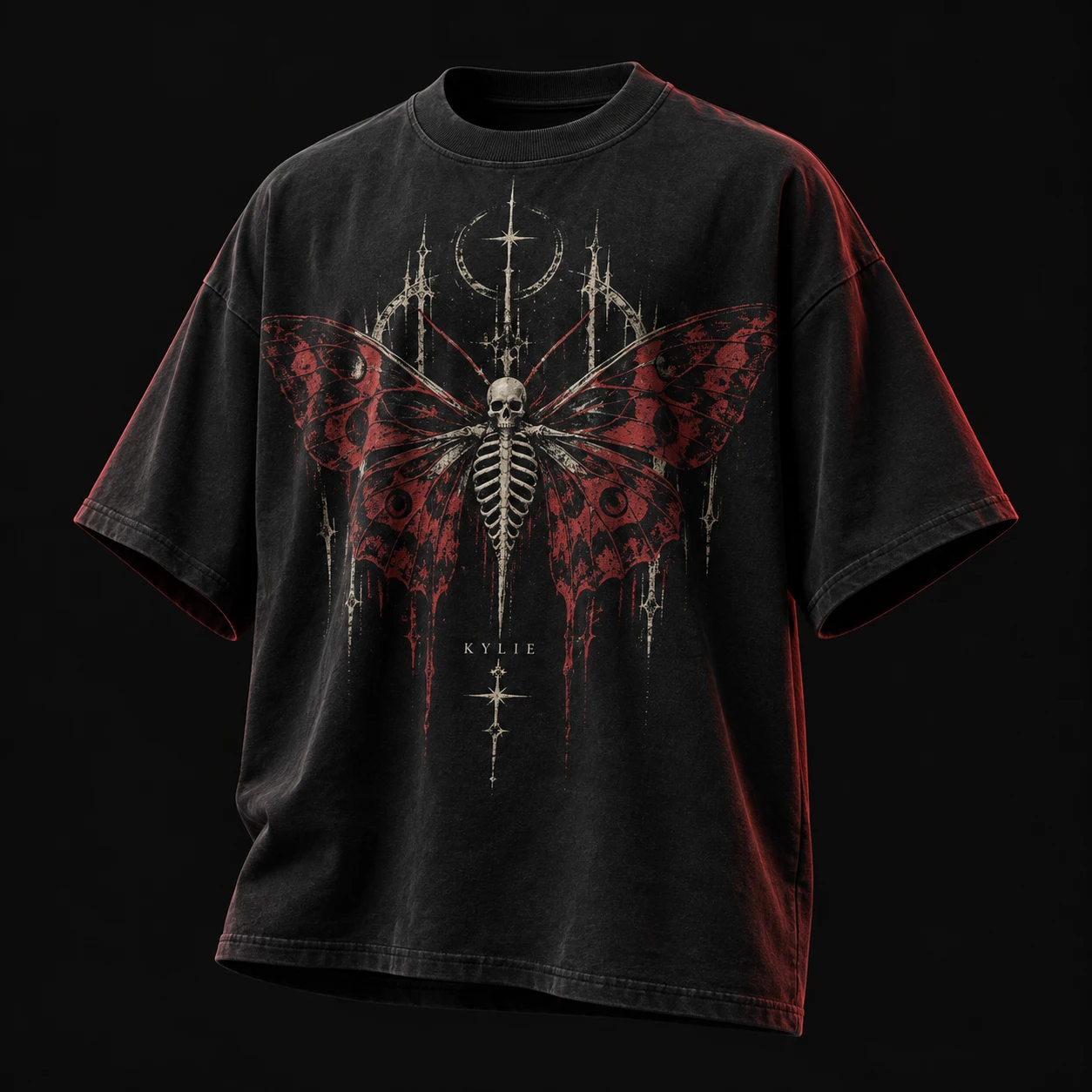
Start with an actual silhouette
Before requesting a quote, describe what boxy means for your collection. Do you want a wide, short body, a more conventional length with dropped shoulders, or a broad sleeve that changes how the tee sits under a hoodie? Treat those as separate choices. The label ‘oversized’ leaves room for different interpretations.
Current product specifications make that distinction useful. AS Colour describes its Heavy Tee through a relaxed boxy fit, dropped shoulders and wide neck ribbing, alongside its fabric specification. Stanley/Stella describes the Blaster 2.0 as oversized with a mock-neck collar and dropped shoulders. These are examples of available designs, not evidence that one shape is selling faster than another.
Sources: AS Colour · Stanley/Stella
Compare the fabric and the fit separately
GSM means grams per square metre: it describes fabric mass per area. For a US-facing brief, check that a weight quoted in ounces refers to fabric weight per square yard rather than the total weight of a garment. Ask the supplier to confirm the unit instead of comparing unlabelled numbers.
The two product references illustrate why shape and weight belong in separate fields. AS Colour lists the Heavy Tee at 8.2 oz with a cotton construction; Stanley/Stella lists the UK Blaster 2.0 at 200 GSM in single jersey. Their published fit descriptions still share oversized or boxy features. Those examples do not establish an ideal weight for your collection, and neither specification is a promise about Kylie's available fabrics.
Our recommendation is to compare swatches and samples against a written use case. Describe whether the tee will be worn alone, under a sweatshirt, or as part of a coordinated drop. Record the desired surface feel, appearance and body shape. If two candidates use different fabrics and patterns, do not attribute every visible difference to weight.
Sources: AS Colour · Stanley/Stella
Make the measurements reproducible
Use a reference garment you can measure, rather than asking a supplier to infer dimensions from a model photograph. Prepare front and back photographs with the measurement points marked. Record the reference size, the units and how each measurement was taken. Explain which aspects you want to retain and which you want to change.
The following is a proposed briefing checklist, not a universal fit standard. Agree the final measurement method, acceptable variation and size grading with your manufacturer. A single reference size does not define the entire size range.
- Body width: show the exact position where it is measured across the laid-flat garment.
- Body length: identify the starting point and whether rib or binding is included.
- Shoulder position and sleeve: record the seam position, sleeve length and opening you want reviewed.
- Neck: show the opening shape and rib depth, together with a clear photograph.
- Hem and overall balance: explain how the front, back and sleeve lengths should look together.
- Size range: request a grading proposal and identify which sizes need physical fit review.
Review how the sample changes after care
CottonWorks explains that dimensional change in cotton fabrics depends on construction and processing, with finishing and garment care also involved. It describes several causes of shrinkage rather than a single universal percentage. That is a reason to test the actual proposed garment under an agreed procedure instead of assuming every cotton tee will behave the same way.
For your sample review, record measurements before care and again after the agreed wash and drying process. Keep the procedure attached to the notes so another person can understand what was compared. Use the same measurement points and units, and distinguish a changed measurement from a changed appearance.
Agree what result is acceptable for your garment before approving production. Ask the supplier which checks it can perform and whether independent testing is needed for your requirements. This guide does not assign a pass percentage or claim that a Kylie sample has been tested.
Sources: CottonWorks
Place the artwork on the chosen shape
Once the sample shape is clear, review your artwork at an actual physical size. A digital graphic centered on a flat mockup still needs an agreed placement on the garment. Specify the artwork width and height, its position relative to a named reference point, and any areas that must remain clear.
Our recommendation is to photograph the intended placement on the sample and keep the approved artwork file with the specification. Decide whether artwork size stays constant across the size range or changes. Ask for a decoration sample on the proposed fabric before treating a screen mockup as the finished result.
Send a brief that produces comparable answers
A useful enquiry tells the manufacturer what decisions are fixed and what still needs development. Include your reference measurements, fabric preferences, decoration files, intended quantities by size and color, and target release date. Ask for the sample process, quotation assumptions and production schedule to be stated explicitly.
Keep a short decision record with three columns: agreed, still to review, and changed since the previous sample. That makes a later conversation more precise than a message saying the tee should feel more premium. For a capsule with hoodies or shirts, review the garments together before freezing the proportions.
Kylie Industry's development enquiry is a place to share that brief and discuss the next steps. Confirm available materials, minimum quantities, pricing and timing for your particular project. The goal is a specification both sides can follow, from the first sample to the final production decision.
Continue your brief
Research and sources
This guide combines published source material with practical specification recommendations. It is not a physical test of the products mentioned. Product examples are references, not endorsements or affiliations.
- Heavy Tee 5080 — AS Colour. Checked 2026-09-16.
- Blaster 2.0: unisex oversized high-neck T-shirt — Stanley/Stella. Checked 2026-09-16.
- Shrinkage and Skewing — CottonWorks. Checked 2026-09-16.