
Use UK product references to identify decisions
Cargo references can combine quite different details. Carhartt WIP’s UK Regular Cargo Pant page describes a regular, low-waisted shape, multiple patch pockets and double-layer knees. Route One’s Classic Cargo Pants list side patch pockets with concealed poppers and pleated knee panels. These are published design examples, not evidence of increasing UK demand or a specification for Kylie production.
For your own streetwear label, annotate the feature you want from each reference. You might want the clean appearance of a covered fastening, a particular pocket proportion or extra room around the knee. Keep these as separate decisions. Copying a photo into a brief leaves the manufacturer to infer which details matter, and the same pocket position may look different on a lower or higher rise.
Sources: Carhartt WIP · Route One
Write the pocket’s job before choosing its size
Our recommendation is to assign each pocket a purpose: quick hand access, carrying a phone, holding small items or creating the intended silhouette. A decorative pocket is a valid choice; label it clearly so nobody assumes it has a carrying function.
For a phone pocket, measure the intended phone with its case and nominate that as the sample reference. Record the usable opening separately from the outside pocket width. Ask for the usable internal depth and any expansion detail to be shown too. The final dimensions and clearance should be agreed through sampling, rather than taken from a generic phone-pocket measurement. Decide whether the item must sit fully below the opening and whether the flap must close while it is inside.
Anchor placement to a repeatable measurement
Helen’s Closet’s cargo-pocket tutorial recommends trying the constructed pocket against a worn pair of trousers to choose its position. It also calls attention to the existing inner pocket bag and checks that the pockets on both legs sit at the same level. That is useful construction context, although its pattern dimensions are specific to its own design.
For a production brief, we recommend recording vertical placement from a named finished waistband edge to a named pocket edge, plus horizontal placement relative to the side seam. Include a small labelled drawing showing the measurement path. Use one unit throughout, such as centimetres, and say whether the left and right pockets should match or deliberately differ.
Check the placement on the intended trouser fit. Review the smaller and larger proposed sizes as well: ask whether the pocket dimensions stay constant or change, and how its position changes with the garment.
Sources: Helen’s Closet Patterns
Choose the fabric with the pocket assembled
CottonWorks describes twill by its diagonal woven pattern. “Twill” therefore identifies a construction feature; your material brief still needs the intended composition, weight and finish. Carhartt WIP’s reference page lists its main fabric and pocket lining separately, a useful reminder to name each material in your own brief.
We recommend comparing the intended cloth in a sewn pocket sample as well as as a loose swatch. Look at the empty pocket, its corners and the way the flap lies when the agreed item is inside. Ask whether the pocket, flap and any lining use the same cloth. If you want a crisp shape or a softer, collapsed appearance, provide a visual reference and record that preference for sample review.
Sources: CottonWorks / Cotton Incorporated · Carhartt WIP
Review closures and reinforcement as separate choices
Route One’s example explicitly specifies concealed poppers on its side pockets. A brief that only says “flap pocket” leaves this detail open. Specify whether you want a popper, button, zip, another closure or no fastening, and show where it should sit.
Helen’s Closet’s tutorial uses bar tacks at the pocket’s upper corners and flap sides. Treat that as an example of reinforcing selected points, not a universal durability guarantee. Ask your manufacturer to propose the attachment and reinforcement details for the agreed fabric and use.
At sample review, operate the actual closure with the pocket empty and with its nominated contents. Record access, flap coverage and any pulling or distortion. A hand check cannot establish a rated carrying capacity; agree any required performance testing separately.
Sources: Route One · Helen’s Closet Patterns
Copy this six-field pocket brief
Use one record for each distinct pocket. This is our proposed buying worksheet; fill in the values with your supplier and retain the approved revision.
- Identity and purpose: pocket name, left or right side, everyday item to carry, or decorative use only.
- Finished geometry: outside width and depth, usable opening, usable internal depth, flap coverage and any intended expansion.
- Position: named waistband reference, pocket reference edge, relation to side seam, measurement units and a labelled drawing.
- Materials and assembly: pocket cloth, lining if used, flap support, closure reference, proposed stitching and reinforcement.
- Size handling: sample size, intended size range, which pocket dimensions change by size and which stay fixed.
- Approval record: sample revision, contents used for review, annotated photos, agreed tolerances and unresolved changes.
Review access while the wearer moves
Our suggested review sequence is to photograph the empty sample from the front and side, then repeat with the agreed everyday items. Ask the wearer to sit, stand, walk and comfortably bend the knee. Check whether they can reach and close the pocket, whether its contents press awkwardly against the leg and whether the opening pulls out of shape. Record observations for that sample and wearer; do not generalise them into claims about every customer.
For example, a hypothetical sample might hold the chosen phone while standing but put it against the knee when seated. Log the observed problem before choosing a remedy. Discuss a position change, a different usable depth or another pocket allocation, then review the revised sample using the same item and sequence. This gives the next sample a clear question to resolve.
Send a decision-ready cargo enquiry
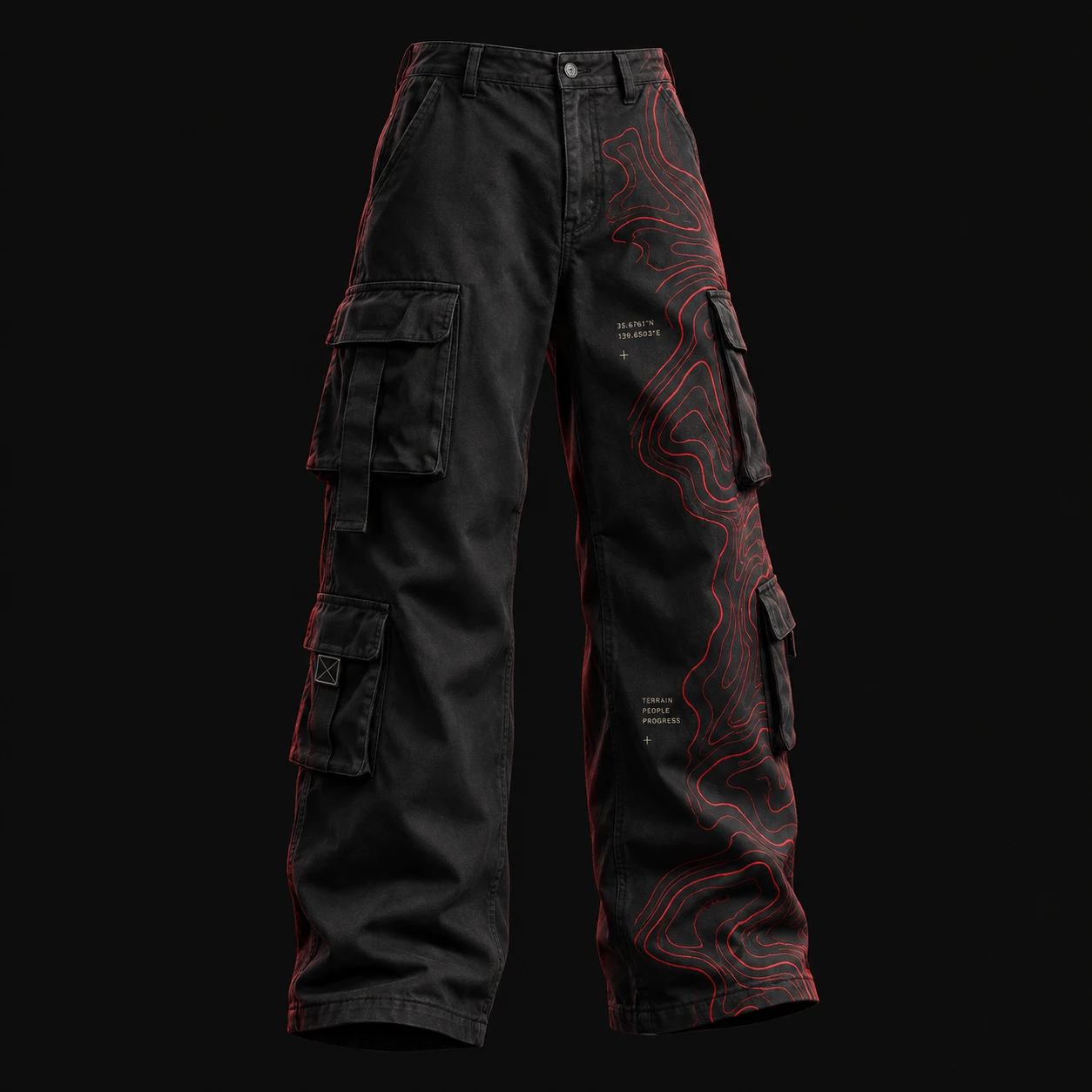
Bring your marked references, pocket worksheet, intended size range and sample priorities to Kylie Industry. The Terrain cargo concept linked below can start a design conversation; its physical specification still needs approval. Ask the team to confirm the proposed materials, construction, quantities, sample costs and schedule for your project. Keep the final drawing and approved sample under the same revision so later changes remain visible.
Continue your brief
Research and sources
This guide combines published source material with practical specification recommendations. It is not a physical test of the products mentioned. Product examples are references, not endorsements or affiliations.
- Regular Cargo Pant — Black, garment dyed — Carhartt WIP. Checked 2026-09-24.
- Route One Classic Cargo Pants — Charcoal — Route One. Checked 2026-09-24.
- How to Sew a Cargo Pants Pocket — Helen’s Closet Patterns. Checked 2026-09-24.
- Basic Woven Fabric Designs — CottonWorks / Cotton Incorporated. Checked 2026-09-24.