A seasonal reference, translated into a development decision
For a UK brand planning an autumn collection, a layered outfit can provide a clearer development brief than two disconnected product sketches. Start by deciding which garment sits outside, whether the shirt should close over the hoodie, and how much of each piece remains visible. In this guide, an overshirt means the shirt intended to be worn as the outer layer.
Goldwin's Fall 2026 collection groups hoodies and shirts within its looks, including the Comfortable Shirt and WF Light L/S Hoodie. That is a current collection reference for considering pieces together. It does not establish rising UK demand or prove that every shirt should fit over every hoodie. Our recommendation is to translate the layering idea into a compatibility check for your own designs.
Sources: Goldwin
Write the intended outfit into both briefs
Name the companion garment and its sample version in each brief. A hoodie approved with a lightweight open shirt is a different review from one approved under a buttoned overshirt. If your campaign will show both arrangements, include both in the fitting session. Describe the intended customer and size range without assuming that a UK size label defines a particular body shape.
Use the actual intended underlayer where possible. If you must substitute one, record what differs and leave the combined fit awaiting confirmation. Ask the manufacturer to review the pair rather than simply increasing every overshirt measurement. Additional body width may not resolve a restriction located at the upper arm or armhole.
- Identify the hoodie, overshirt and any base layer by sample code and version.
- State whether the overshirt must work open, fully fastened, or both.
- Describe the intended visible hems, sleeve ends and hood position.
- Agree the measurements and acceptable tolerances before approving the pair.
Inspect where the garments meet
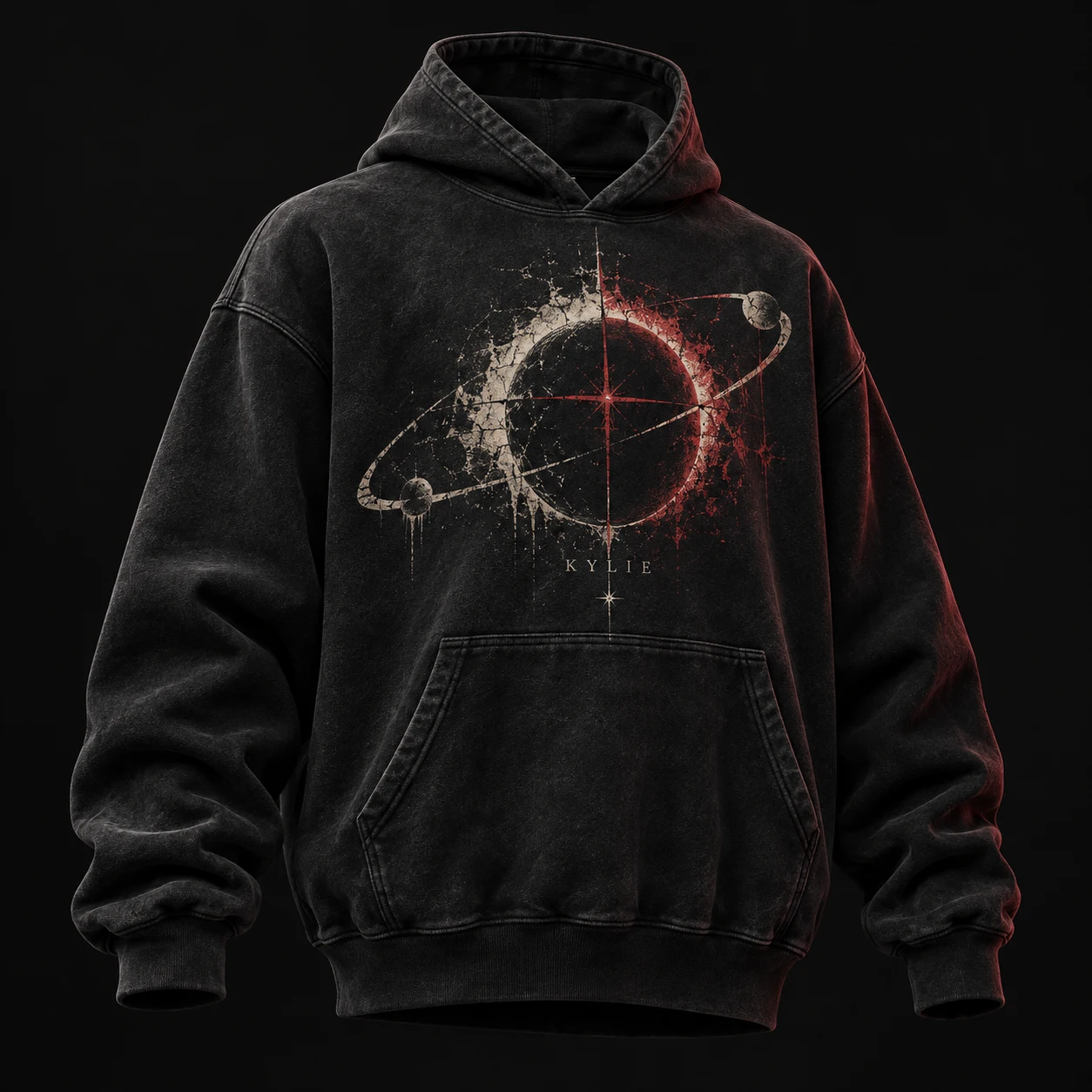
Construction details deserve their own check. AS Colour UK's Stencil Hood specification lists a lined hood, inset sleeves, a kangaroo pocket and cuff ribbing. These details illustrate why the word hoodie alone leaves important decisions unresolved. They are specifications for that product, not a description of a Kylie Industry garment.
For your pair, look at the contact points rather than relying on the size names. Does the overshirt collar sit as intended beneath the hood? Does the shirt front pass comfortably over the hoodie pocket? Do the sleeve layers settle naturally, or must someone arrange them repeatedly for a photograph? Treat these as questions to resolve on the samples, not outcomes that a product description can guarantee.
Sources: AS Colour UK
Use a repeatable outfit fitting sequence
The following is an editorial checklist, not a laboratory test standard. Keep the wearer, sample pair and photography positions consistent so that revisions are easier to compare. Assess each garment alone first, then together: that helps locate whether a problem belongs to one piece or appears only in the combination.
- Open overshirt, hood down: photograph front, side and back. Record hem balance and whether the hood obscures a detail intended to remain visible.
- Fastened overshirt, hood down: check the button line and chest while standing and sitting. Note pulling, gaping or pocket bulk.
- Hood up, then down: check head movement and how the collar and hood settle after the change.
- Arms forward and elbows bent: record restriction at the back, shoulder and upper sleeve. Check whether the layers return to the intended position.
- Cuffs and pockets: check sleeve overlap, wrist comfort and access to the pockets intended for use when the outfit is layered.
Check the relationship again after care
CottonWorks explains that dimensional change depends on factors including fabric construction, processing, finishing and garment care. Its guidance also notes that knitted fabrics are generally more susceptible to dimensional change than woven fabrics. This supports checking the finished pieces; it does not supply a shrinkage prediction for your particular hoodie or shirt.
Agree a care procedure appropriate to each garment with your manufacturer. Do not wash both together simply because they form an outfit if their intended care instructions differ. Record each procedure, the before-and-after measurements and the number of cycles assessed. Then put the pair together again and repeat the same fitting sequence. A satisfactory first fitting does not settle how the layered proportions look after care.
Compare the relationship between the two pieces as well as their individual measurements. A change in sleeve or body length may alter how much of the hoodie shows. Ask for evidence against your agreed acceptance criteria; avoid approving a generic shrinkage percentage without a defined method.
Sources: CottonWorks
Make the approval specific enough to repeat
Record each observation with the outfit configuration, the location of the issue, a photograph reference and the requested next step. For example: overshirt fastened, arms forward, restriction across upper back; review the relevant pattern area and return the revised pair for fitting. That describes the problem without guessing a universal centimetre adjustment.
Approve the combination separately from the individual garments. Keep the paired sample references, fit notes and care results together. If a later change affects the hood, sleeve, cuff, pocket or fabric, decide whether the paired fitting needs to be repeated before signing it off.
For your Kylie Industry enquiry, share the intended layering order, reference images, size range, artwork and the conditions in which the outfit should work. The useful starting point is a clear account of the interaction you want between the hoodie and shirt. Confirm the construction, sampling scope and production details directly for your project.
Continue your brief
Research and sources
This guide combines published source material with practical specification recommendations. It is not a physical test of the products mentioned. Product examples are references, not endorsements or affiliations.
- Fall Collection 2026 — Goldwin. Checked 2026-09-17.
- Stencil Hood 5102 — AS Colour UK. Checked 2026-09-17.
- Shrinkage & Skewing — CottonWorks. Checked 2026-09-17.