
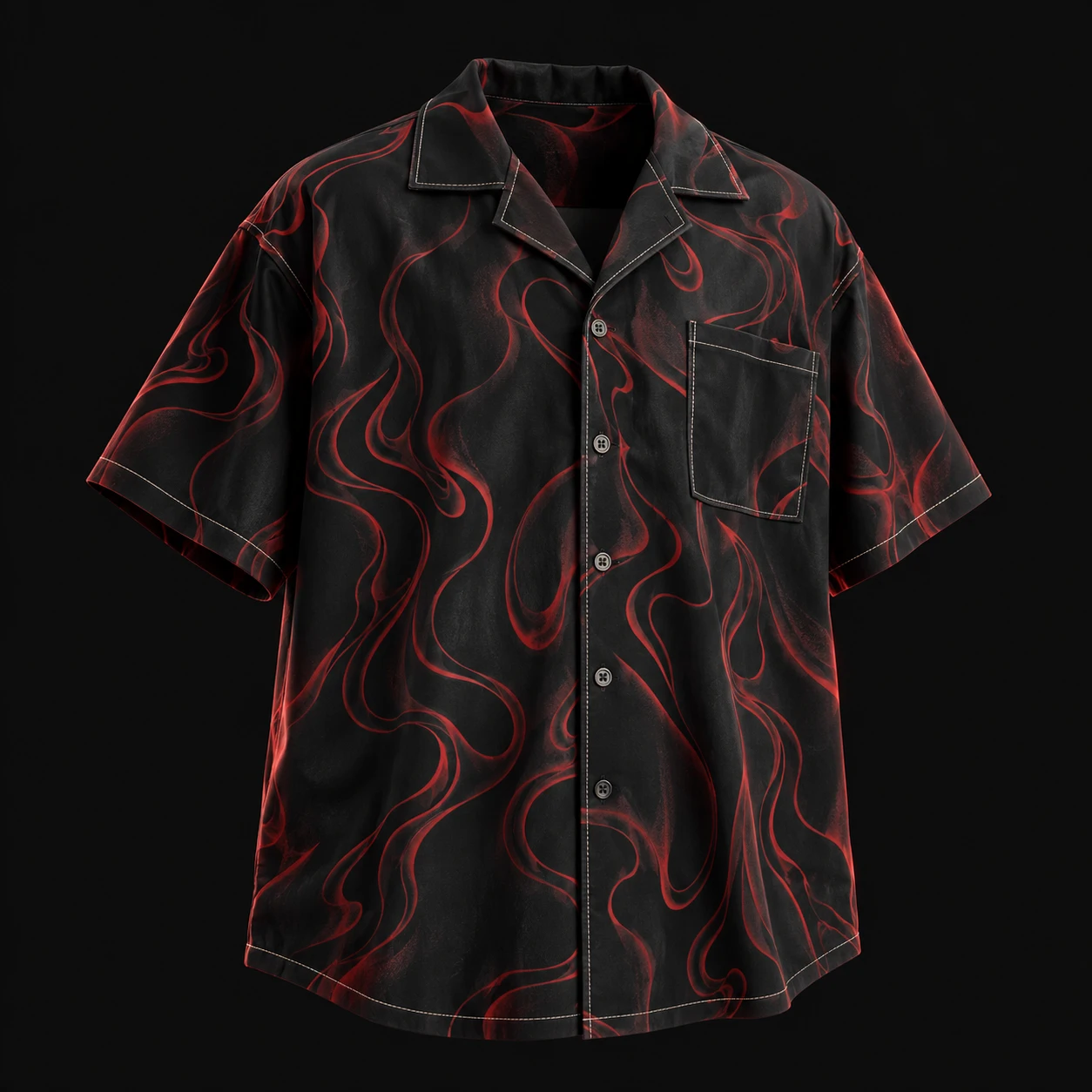
Decide what must stay in the same place
A printed button-up shirt needs an artwork brief that accounts for its front opening, collar, sleeves and pockets. For a US clothing brand, start by deciding whether the identity comes from a particular image in a fixed position or from the overall rhythm of a pattern. That decision is more useful than asking for an all-over print without explaining the intended result.
In this guide, placement means locating an image relative to named garment points. Repeat means arranging copies of a design tile across an area. You can combine them: for example, a repeating background with a separately positioned chest emblem. Give each component its own specification so the supplier can explain how it would be made.
The layout does not, by itself, select the printing process. CottonWorks describes multiple fabric-printing techniques and notes that both fabric and garments can be printed. Ask the manufacturer to explain whether the proposed artwork will be applied to fabric, cut panels or the assembled garment, and how that choice affects the design.
Sources: CottonWorks / Cotton Incorporated
Describe the repeat, not just the individual motif
A tile is the unit that repeats; the motif is an image within it. A small drawing can sit inside a larger tile with generous space around it. Record both the intended motif size and the tile dimensions, rather than sending an isolated image and expecting the spacing to be inferred.
Spoonflower’s repeat guide distinguishes a straight grid from staggered arrangements, including half-drop and half-brick layouts. Adobe’s pattern documentation separately identifies tile width, height, spacing and the visible repeat boundary. These are useful design controls to record, even if your supplier uses different software.
Our recommendation is to supply the production artwork plus a preview showing several repeats at the intended scale. State the repeat type and mark which way is up. If motifs may rotate or mirror, show that explicitly. For a US brief using inches, identify the units on every drawing and agree any metric conversion with the supplier.
Sources: Spoonflower · Adobe
Give placement artwork a fixed reference
For a single back graphic, record its printed width and height and locate it from a clearly named point, such as the center back and an agreed seam. A note saying centered is incomplete unless both sides know what it is centered within. The same applies to a chest motif placed beside a pocket or the front opening.
Use separate views for the front, back and sleeves. Mark whether dimensions refer to the finished garment or the cutting pattern. Ask the sample maker to confirm the reference points, any area that cannot be printed as drawn, and the acceptable placement variation before approval.
Also decide how placement should behave across sizes. You might want one artwork size throughout, or a planned change for selected sizes. Neither approach should be assumed from a single medium-size mockup. Request the relevant layouts for review and identify which sizes need a physical sample.
Separate a seamless file from a matched garment
Spoonflower warns that gaps or misalignment at tile edges can appear as lines or boxes when the artwork repeats. It recommends checking the repeated design and using physical swatches to assess printing. That addresses continuity within the artwork; it does not establish how separately cut shirt pieces will align after sewing.
Our recommendation is to mark every joining area that matters visually. A seamless digital repeat is not a promise that a motif will continue across a pocket, button opening or side seam. Ask the manufacturer to review those requests against the proposed pattern and production process.
For a hypothetical palm-print shirt, you might accept varied motif positions across the body but require the chest pocket to blend into the surrounding print. Alternatively, you might want the pocket deliberately offset. Show the desired result and identify it as essential, preferred or unrestricted; do not leave both interpretations in the same brief.
Sources: Spoonflower
Build an artwork approval sheet
The following is an original briefing checklist for discussion with your manufacturer. It is not a universal cutting rule or a claim about Kylie Industry’s available processes. Keep the sheet with the artwork file and sample reference so every approval refers to the same version.
- Artwork identity: file name, revision, colorway and the person authorized to approve changes. Keep any preview clearly labeled as a preview.
- Scale and direction: motif dimensions, repeat dimensions and layout, or placement dimensions and reference points. Include the units and orientation.
- Front opening: show the shirt fastened and identify any graphic that should read continuously across the opening. Ask how overlap affects the visible result.
- Pockets and collar: state whether the print should match, contrast or vary freely. Identify any motif that must remain whole or visible.
- Sleeves and seams: mark where direction or continuity matters, including whether left and right sleeves should look alike. Request feasibility confirmation.
- Size range: record which artwork details stay fixed and which may change. List unresolved layouts before approving the full order.
Approve the print and the sewn shirt separately
Request a printed proof on the proposed material to review color, detail, scale and the repeat joins. A print sample is often called a strike-off; confirm exactly what your supplier means by that term and what it includes. Identify the fabric and artwork revision on the approved reference.
Then review the assembled shirt with the front fastened, open and worn as intended. Check the agreed pocket, collar and seam priorities against the approval sheet. A satisfactory flat swatch cannot show the effect of the front overlap or the final position of a pocket.
Agree an appropriate care review for the finished garment and record the conditions alongside any observations. If artwork, fabric, pattern or construction changes afterward, identify which approvals need repeating. Keep the approved files and physical references together instead of relying on an unversioned message saying the print is fine.
For your Kylie Industry enquiry, send the repeat tile or placement artwork, a scaled preview, shirt references, size breakdown and alignment priorities. Ask the team to confirm the proposed process, sample scope and any unresolved production details. The aim is a printed shirt whose visible layout can be checked against a clear, shared brief.
Continue your brief
Research and sources
This guide combines published source material with practical specification recommendations. It is not a physical test of the products mentioned. Product examples are references, not endorsements or affiliations.
- Printing Process — CottonWorks / Cotton Incorporated. Checked 2026-09-23.
- Repeat Options — Spoonflower. Checked 2026-09-23.
- Edit patterns — Adobe. Checked 2026-09-23.
- Checking for Repeat Flaws in Designs — Spoonflower. Checked 2026-09-23.