
Give garment balance its own approval
For a UK label developing a relaxed or graphic tee, our recommendation is to include garment balance in the sample brief. A front photograph communicates the design, but a production decision also needs an identified sample and a record of how its shape changes after care. Describe a seam that moves towards the front or back instead of simply calling the fit wrong.
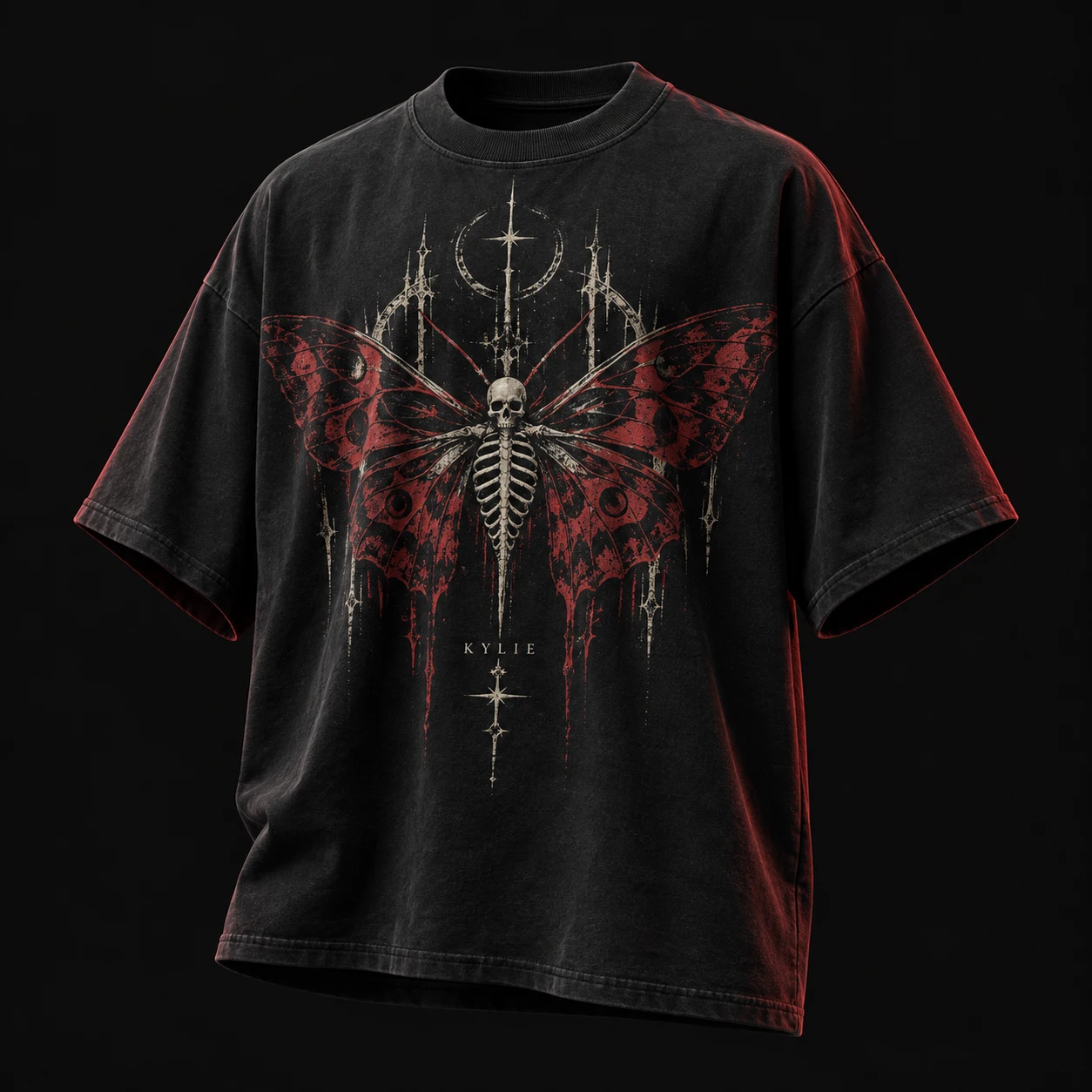
Parlez’s current UK assortment includes the Winside tee with a relaxed fit and front-and-back graphics. That is a useful design reference, not evidence that demand is increasing. The practical question for your own design is whether the garment and artwork still sit as intended after the agreed care process.
Sources: Parlez
Separate shrinkage, fabric skew and garment twist
CottonWorks explains that dimensional stability depends on construction and processing, with garment care also involved. Its guidance includes skew and changes in garment appearance alongside shrinkage. These terms should prompt different observations: length or width change is not the same observation as a side seam moving around the body.
Use a simple comparison in your development notes: size measurements answer ‘has the tee become shorter or narrower?’; seam-location photographs answer ‘has its balance changed?’ Record both, even when only one is outside the agreed acceptance criteria. A visual observation helps describe the problem; it does not establish the percentage or cause of spirality.
Sources: Cotton Incorporated / CottonWorks
Choose evidence for the garment you are buying
ISO 16322-3:2021 describes procedures for garment spirality after domestic laundering. Its public scope warns that different procedures may not give comparable results and excludes as-manufactured spirality. Ask a laboratory to identify the procedure used rather than accepting a report labelled only ‘twist tested’. This guide uses the public scope, not the full purchased method.
AATCC’s 2026 manual announcement distinguishes TM179-2025 for fabric skew change from TM207-2025 for garment seam twist before and after home laundering. It also notes revised laundering references. A fabric report and a finished-garment report therefore answer different questions. Our recommendation is to confirm the specimen, method edition and applicable procedure with the testing provider before comparing results.
Do not prescribe a sewing fix from a photograph
CottonWorks’ skewing Q&A discusses yarn, knitting and processing influences. It also explains that cutting to disguise initial skew does not necessarily prevent side seams from skewing after washing and drying. An initially straight-looking tee is therefore insufficient evidence of its later appearance.
Our recommendation is to send the supplier the identified garment and observations, then ask it to investigate the fabric and garment process together. Avoid instructing ‘move the seam back’ as the only remedy. If a material or processing change is proposed, require an identified replacement sample and repeat the relevant review before approving it.
Sources: Cotton Incorporated / CottonWorks
Use a seam-location review sheet
The following is our proposed development record, not a substitute for a standard laboratory procedure. Complete it for each combination selected for review with the supplier. For a UK-facing brief, specify measurement units explicitly, such as centimetres or millimetres, and state wash temperature in degrees Celsius. Keep the same agreed presentation and measurement approach across comparable samples.
- Identity: style, sample revision, size, colourway, fabric reference, finish and whether the garment has side seams. Identify the actual sample tested in any report.
- Before care: retain front, back and both side views. Mark the intended side-seam position and record any existing rotation or asymmetry before attributing it to washing.
- After care: photograph the same areas after the agreed washing, drying and sample preparation. Record where the seams sit relative to the front and back, without pulling them into the desired position for the photograph.
- Related appearance: note hem balance and the position of front or back artwork. Keep these observations separate from print cracking, colour change and length or width measurements.
- Evidence: attach the procedure, completed cycles, evaluator and report reference. If a numerical result is supplied, include its method, units and calculation basis so two unlike values are not treated as equivalent.
- Decision: record the agreed acceptance criterion, observed result, pass or hold decision, and the exact revision or investigation required. Name who approves the next sample.
Agree acceptance before the sample is judged
Set your acceptance criteria with the supplier and, where relevant, the testing laboratory before approving production. CottonWorks’ Q&A explicitly describes a quoted industry percentage as an unofficial preference rather than a standard. This article consequently supplies no universal pass percentage for every tee.
For a hypothetical example, a tee might retain the approved chest width and body length but show one side seam visibly moving onto the front after care. Record the dimensional measurements as acceptable and the seam-alignment decision as unresolved. Do not average these findings into a vague overall pass. Ask for the investigation and replacement evidence needed to close that specific issue.
Where a design uses tubular construction without side seams, ask the laboratory which garment features and procedure can answer your question. The absence of a side seam removes that particular visual reference; it should not become an unsupported promise that the garment cannot twist.
Sources: Cotton Incorporated / CottonWorks
Carry the result into the production brief
Our recommendation is to retain the accepted physical sample, its evidence and the approved material and process references together. Ask which changes would require renewed review, including a different fabric, finish or construction. Establish how the supplier will confirm that the production proposal corresponds to the approved sample; a good result on an unrelated tee does not settle your order.
To discuss a T-shirt project with Kylie Industry, send your fit reference, intended UK market, artwork, size and colour breakdown, and completed seam-location review sheet. Ask what sample checks or independent testing can be arranged and confirm the scope, cost and timing. Use the linked fit guide for proportions and the print guide for decoration durability, while keeping the garment-balance approval clearly identified.
Continue your brief
Research and sources
This guide combines published source material with practical specification recommendations. It is not a physical test of the products mentioned. Product examples are references, not endorsements or affiliations.
- Shrinking and Skewing — Cotton Incorporated / CottonWorks. Checked 2026-10-17.
- Skewing webinar questions and answers — Cotton Incorporated / CottonWorks. Checked 2026-10-17.
- ISO 16322-3:2021 — Spirality after laundering: woven and knitted garments — ISO. Checked 2026-10-17.
- Announcing the 101st Edition of the AATCC Manual of International Test Methods and Procedures — AATCC. Checked 2026-10-17.
- Winside T-Shirt White — Parlez. Checked 2026-10-17.