
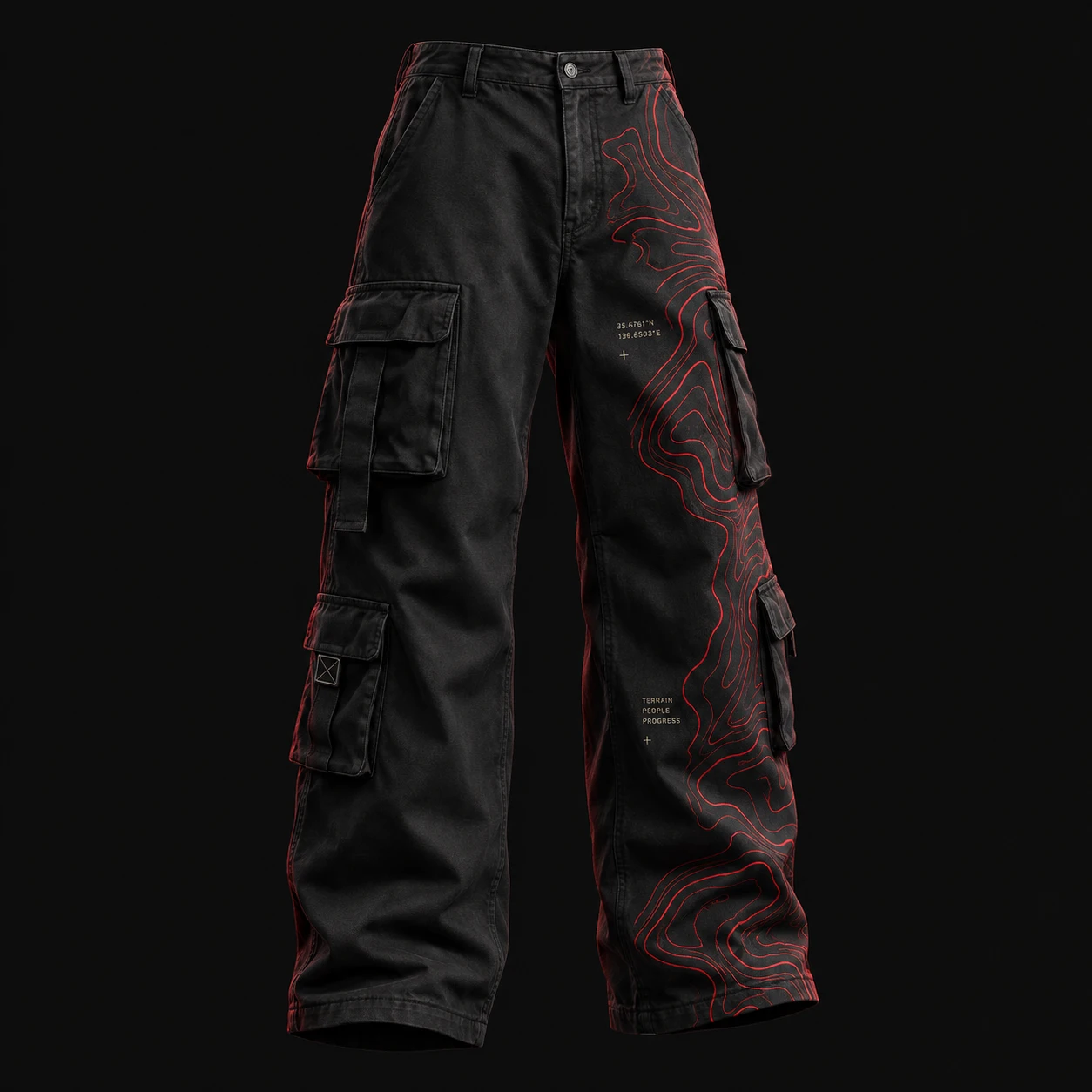
Turn current cargo references into a construction question
The adidas and Arte Antwerp announcement dated 13 October 2026 describes wide-leg cargo pants as a coordinated styling option for its winter drop. Carhartt WIP’s German Fall/Winter 2026 lookbook also includes the Osborn Cargo Pant. These are current design references from separate businesses; they do not demonstrate rising demand or establish the quality of an unseen seam.
For a label selling in Germany, France or other European markets, our recommendation is to name the intended wearing situation alongside the reference image. A relaxed everyday trouser and a style intended for carrying items need a clearly described brief. Record the actual countries and customer use; the word Europe does not supply one universal construction requirement.
Sources: adidas · Carhartt WIP
Distinguish yarn movement from a broken join
AMANN describes seam slippage as movement of the fabric’s warp and weft yarns relative to one another around the seam under transverse tension. Warp and weft are the two crossing yarn directions in woven cloth. The fabric can open around a join even when the sewing thread has not broken. Seam breaking strength concerns resistance to force applied across the seam and depends on fabric, thread and sewing parameters.
In your sample notes, describe what is visible before deciding on a correction. Is the thread broken, is the cloth damaged, or have yarns moved apart? Take close photographs of the outside and inside with the sample identified. A photograph may document an opening, but it does not identify the cause or establish a laboratory result. Ask the supplier to investigate rather than automatically requesting thicker thread.
Sources: AMANN Group
Give each important seam an identity
Our proposed starting point is a seam map: a simple front-and-back drawing with numbered joins. Include the seat seam, inside and outside leg joins, waistband attachment and any pocket attachment selected for review. Discuss priorities with the manufacturer; a decorative topstitch is not automatically the structural join underneath it.
For each selected area, record the proposed seam construction, stitch type, seam allowance, thread reference and stitch density. Seam allowance is the cloth between the stitching line and the cut edge. Request a section drawing or an inside photograph when a name is unclear. State units consistently and retain the fabric reference, finish and sample revision with the map.
This record makes a comparison interpretable. If one sample uses a different fabric and a different seam construction, you are comparing two complete options. You cannot credit the result to the extra stitch line alone. Keep intended fit and movement review separate so a construction change does not conceal an unresolved sizing issue.
Choose evidence that answers the specific question
ISO 13936-1:2004 identifies a fixed seam opening method for assessing resistance to yarn slippage at sewn seams in woven fabrics. ASTM D1683/D1683M-22 addresses failure in sewn seams of woven fabrics under force applied perpendicular to the seam. Its public scope explicitly says that the method does not predict actual wear performance. A method name should therefore lead to a discussion of scope, not a blanket durability promise.
Ask the testing provider which method and edition suit the proposed cloth and construction, especially if the fabric contains stretch. Confirm whether the specimen represents a prescribed laboratory assembly or the production seam you intend to buy. Agree acceptance criteria for the intended use before interpreting a result. This guide draws on public scopes and does not reproduce the complete test procedures.
For comparable reports, our recommendation is to record specimen identity, fabric direction, conditioning or pretreatment, seam assembly, units, result and observed failure mode. A force value and an opening measurement are different outputs. Do not merge them into one quality score, or compare numbers from different procedures without the laboratory explaining their relationship.
Sources: ISO · ASTM International
Investigate changes with controlled sample comparisons
American & Efird’s technical bulletin lists seam margin, stitch and seam construction, and experimental changes to stitch density as possible areas to investigate. Its examples include trying both higher and lower densities from different starting points. That supports evaluation on the actual fabric rather than a universal instruction to add more stitches. The bulletin also recommends involving the fabric manufacturer.
Our recommendation is to change one identified factor at a time where practical, retaining a labelled control. Ask what changed and why, then review the revised area for appearance, bulk, comfort and the agreed evidence. If several changes must be made together, label the new combination clearly. Do not present a hand pull or a short try-on as certification of seam strength.
Sources: American & Efird
Use this six-field seam approval record
Complete one record for each construction combination selected for approval. The following is our proposed buying checklist, not a substitute for a laboratory method. It connects the sample conversation to the production instructions and makes unresolved decisions visible.
- Location: seam-map number, garment area, sample size and the purpose of that join.
- Material: fabric and colour reference, composition, finish, relevant direction and any difference from the proposed production cloth.
- Assembly: seam and stitch descriptions, seam allowance, thread reference, density and any supporting detail shown in a drawing.
- Observation: inside and outside photographs; distinguish broken thread, damaged cloth and yarn displacement without guessing the cause.
- Evidence: report reference, method edition, specimen construction, preparation, units, results and the agreed acceptance criterion.
- Decision: approve, revise or hold; record the reason, responsible reviewer and exact sample revision needed to close the issue.
Carry the accepted combination into the order
For a hypothetical example, a sample may look clean when laid flat but show yarn displacement at the seat during review. Record that observation and hold the affected construction decision. Ask for an investigation of the actual fabric-and-seam combination, then identify the evidence needed for the next approval. An attractive topstitch should not close an unresolved functional question.
Retain the accepted physical reference and its construction record together. Agree when a change of fabric, finish, thread or seam assembly requires renewed review. For a cargo project with Kylie Industry, send your target markets, fit references, seam map and sample priorities through the enquiry link. Confirm which sampling or independent testing can be arranged, with its scope, cost and timing, before approving production.
Continue your brief
Research and sources
This guide combines published source material with practical specification recommendations. It is not a physical test of the products mentioned. Product examples are references, not endorsements or affiliations.
- Seam stability — AMANN Group. Checked 2026-10-19.
- Minimizing Seam Slippage — American & Efird. Checked 2026-10-19.
- ISO 13936-1:2004: Fixed seam opening method — ISO. Checked 2026-10-19.
- ASTM D1683/D1683M-22: Failure in Sewn Seams of Woven Fabrics — ASTM International. Checked 2026-10-19.
- adidas and Arte Antwerp unveil FW26 winter drop — adidas. Checked 2026-10-19.
- Fall/Winter 2026 Lookbook – Men — Carhartt WIP. Checked 2026-10-19.