
A Canadian autumn reference, followed by a practical buying question
Outclass’s 24 September 2026 collection announcement combines shirts, trousers and knitwear in different fabrics and colours. It is one recent Canadian collection example, not evidence of rising demand for a particular garment or a packing method. For a brand planning its own multi-piece drop, it raises a useful operational question: can the person receiving the shipment identify every variant without guessing?
This guide offers a suggested packing brief for cargo trousers alongside hoodies and tees. The principle also works for other combinations. Decide whether the delivery goes to your own stockroom, a retailer or a fulfilment warehouse. Ask that receiver for its current packing and labelling instructions; a branded bag approved for presentation may still omit information the receiving team needs.
Sources: Outclass
Define the garment variant before counting cartons
Our recommendation is to use one stable internal item code for each distinct style, colour and size combination. Keep the full description beside the code so a person can check it. For trousers, include any separately ordered length or fit option. A line saying “black cargo, 60 pieces” leaves the size breakdown unresolved.
Treat each code as a reference to the approved garment specification, not a substitute for it. For example, a revised pocket layout or a different approved print may need a separate identifier if the two versions must be stocked separately. Agree how the receiver handles these distinctions before labels are printed.
Keep the ordered quantity, packed quantity and received quantity in separate fields. This makes a short shipment visible without rewriting the original order. Record any agreed partial delivery explicitly, and identify which remaining quantities belong to a later dispatch. These are suggested recordkeeping practices, not claims about a standard Kylie order quantity or delivery arrangement.
Use a carton allocation sheet that adds up in two directions
Use one row per variant per carton. Add the rows within each carton to check the physical count, then add each variant across cartons to check it against the order. Keep the packing list version and purchase-order reference visible. The following fictional example illustrates the arithmetic; it does not prescribe a safe carton capacity.
Suppose an order contains 60 black cargo trousers: 20 small, 25 medium and 15 large. A proposed split is carton C01 with 20 small and 10 medium, and carton C02 with 15 medium and 15 large. Both cartons contain 30 garments, but their size contents differ. Labelling both simply “black cargo, 30” would conceal that difference.
For a real order, determine carton size and fill from a physical packing trial and the receiver’s and carrier’s requirements. Do not infer capacity from the example, garment GSM or a photograph. Ask for actual packed dimensions and weight once the proposed configuration has been checked.
- Order reference and packing-list revision; receiving location and agreed delivery grouping.
- Carton reference; style code; colour; size or length variant; quantity in that carton.
- Per-carton total and per-variant total across the shipment, reconciled with the approved dispatch quantity.
- Actual packed dimensions and weight, with units; exception notes; person and date confirming the count.
Separate carton identity from product identity and the shipping label
GS1 explains that a logistics unit can combine items for transport or storage, and that its Serial Shipping Container Code, or SSCC, links that unit to associated information. This is a useful distinction: identifying a transport unit and describing its contents are related tasks, but one does not replace the other.
For your own receiving process, a reference such as C01 can link the carton to the allocation sheet. It is only an internal example, not a valid SSCC. If a retailer or warehouse requires GS1 labels, request its exact specification and arrange correctly assigned identifiers. Do not invent a barcode number or assume that printing a product code satisfies the receiver’s logistics-label requirements.
Keep the carrier’s shipping label separate from your carton-content record. For parcels sent through Canada Post, its guidance calls for a visible label placed flat on the largest side, with a scannable barcode. Old shipping labels and barcodes should be removed from reused boxes. These are carrier-specific instructions, not a universal rule for every freight service.
Sources: GS1 · Canada Post
Approve a packed sample as well as the garment
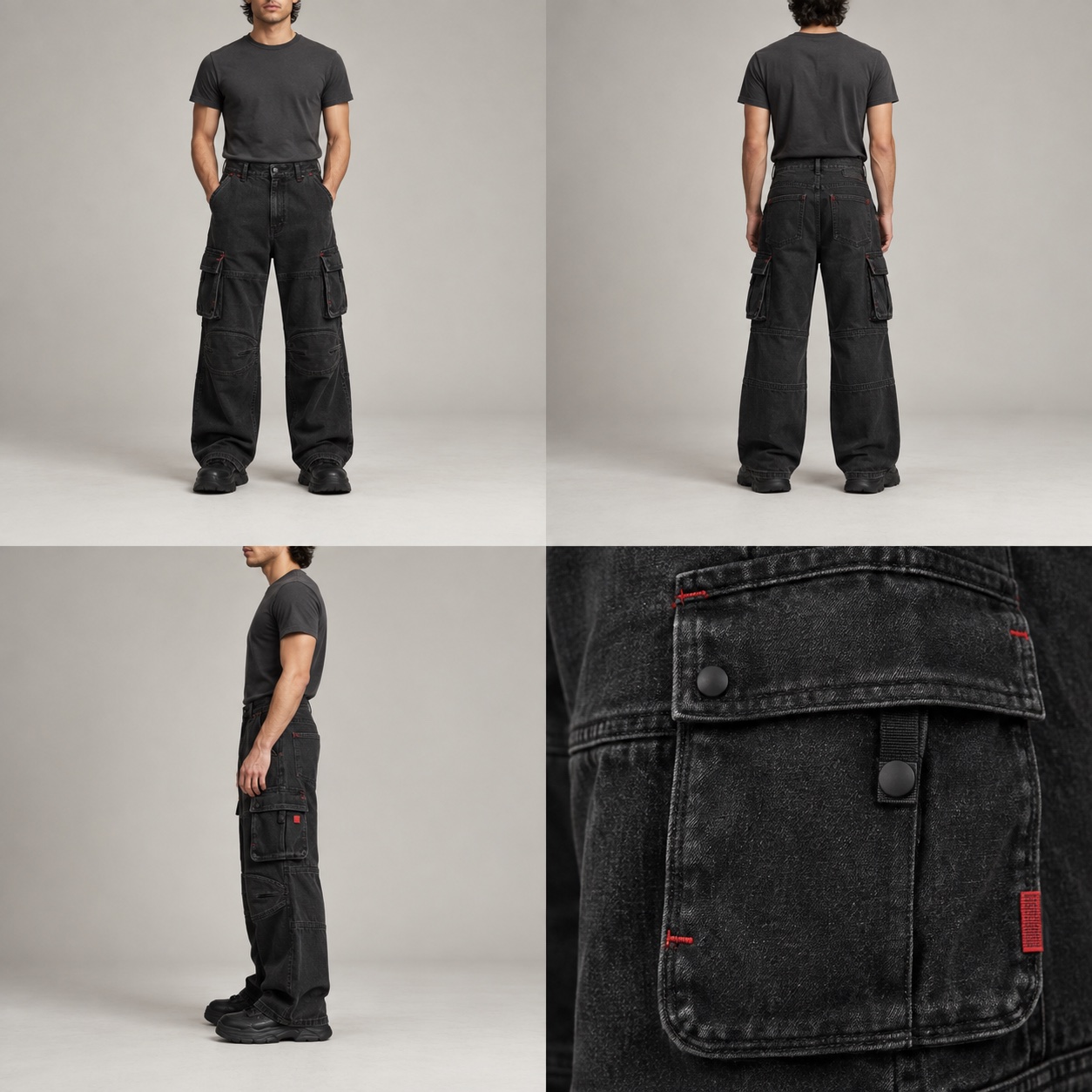
We recommend packing representative approved garments using the proposed folding, individual wrapping and carton arrangement. Photograph the contents before closing, then unpack them and compare their condition with the pre-packing record. For cargo trousers, note pocket flaps, exposed hardware and bulky areas; for decorated hoodies or tees, identify where the fold falls relative to the decoration.
Ask the supplier to explain any visible change rather than assuming that every crease or ripple came from shipping. Coats’ technical guidance describes seam puckering caused by component dimensional changes and uneven fabric feeding. Recording garment condition before packing helps distinguish an existing sewing issue from a change first observed after unpacking.
Canada Post recommends a protective outer container, secure sealing and suitable stabilization of contents. Apply the requirements of the service actually used and assess the proposed pack for the actual garments. This development check does not establish transit-test certification or guarantee damage-free delivery.
Sources: Coats · Canada Post
Close the loop when the shipment is received
Give the receiver the final packing list before arrival through your agreed channel. Our suggested receiving sequence is to record the carton references received, check visible external damage, and count contents against the carton rows. Record the actual result alongside the expected quantity so any discrepancy can be located precisely.
For example, “C02 contains 14 medium trousers against 15 listed” is more useful than “one item missing.” Add photographs and the relevant item code, then reconcile the finding with the supplier. Keep mixed sizes traceable during any repacking so the original evidence is not lost.
For a Kylie Industry enquiry, send the garment designs, style-colour-size breakdown, destination and receiver’s packing requirements. Ask the team to confirm the proposed packing method, sample review, costs and delivery arrangements for your project. The cargo image is a design concept, not evidence of a packed or inspected production order.
Continue your brief
Research and sources
This guide combines published source material with practical specification recommendations. It is not a physical test of the products mentioned. Product examples are references, not endorsements or affiliations.
- AW26 - Delivery No. 1 — Outclass. Checked 2026-10-10.
- What is a Logistics unit and how is it identified? — GS1. Checked 2026-10-10.
- ABCs of mailing — Packaging and wrapping overview — Canada Post. Checked 2026-10-10.
- Eliminating Seam Puckering — Coats. Checked 2026-10-10.