
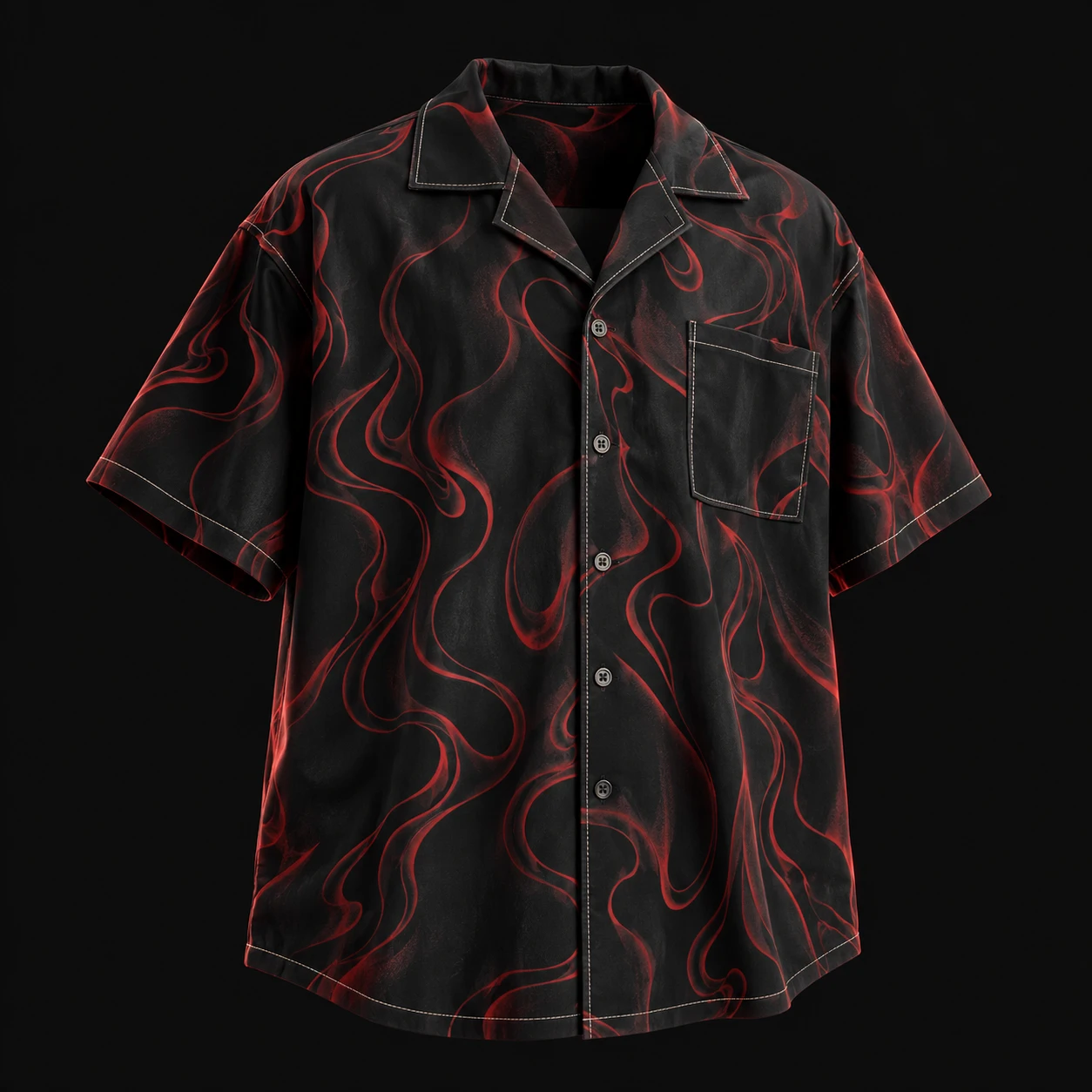
Why the collar needs its own decision
For a European brand developing a printed button-up, the collar brief should explain how the shirt will be worn: open over a tee, buttoned at the neck, or both. Our recommendation is to photograph the reference in those positions and name what matters: a relaxed roll, a defined edge or a particular opening. Avoid treating one look as a preference shared by every European market.
Freudenberg describes support for collar shape as relevant even to casual shirts, and offers both fusible and sew-in interlinings. Interlining is the supporting material within the garment construction. Its presence does not by itself mean the finished collar must feel stiff. The useful buying question is which complete construction produces the intended result.
Sources: Freudenberg Performance Materials
Use seasonal references without guessing the fabric
DESOTO's Fall/Winter 2026 Casual Line describes digital prints that recreate denim, corduroy, flannel and twill appearances on jersey. This is a specific brand's design direction, not evidence that printed shirts are gaining demand across Europe. It also illustrates why a photograph cannot reliably tell a buyer how a material is constructed.
If a reference looks like twill, ask whether your proposed cloth is woven twill, a printed jersey or something else. Record the actual construction and finish before choosing collar support. For your own artwork, keep the print-layout approval separate from the collar-construction approval: an attractive print proof does not show how the finished neckline sits.
Sources: DESOTO
Compare support options using the same outer fabric
Freudenberg's shirt range includes fusible and non-fusible constructions, with different weights and finishing treatments. That range supports asking for alternatives; it does not establish that a named material is suitable for your particular shirt.
Our suggested comparison is two labelled collar samples made with the same outer fabric, shape and intended care. Have the supplier identify the support material and attachment method on each. Ask them to record any construction differences too, so you know what changed. Handle both samples and view them open and closed before choosing. If the supplier recommends only one option, request its rationale and an identified sample instead of assuming alternatives must be available.
Sources: Freudenberg Performance Materials
Do not turn a product instruction into a universal fusing recipe
Vlieseline lists G 700 as a cotton-based fusible woven interlining for small shirt parts such as collars and cuffs, with specified applications and processing guidance. The manufacturer also recommends testing its products for the intended project. These instructions belong to that product; they are not a generic production setting for every interlining.
For a fusible option, our recommendation is to ask the supplier to record the interlining reference, outer-fabric reference and applicable supplier processing instructions with the trial. Have them confirm how the proposed process was checked on the actual combination. Do not copy a hand-iron instruction into an industrial production brief or assume that an interlining's care recommendation proves the care performance of the entire printed shirt.
Sources: Vlieseline / Freudenberg
Inspect the sewn collar before and after agreed care
Coats explains that seam puckering can involve sewing tension, fabric structure, feeding and differences in dimensional change between components. It notes that reinforcement shrinking differently from the base fabric can contribute to puckering. An uneven collar therefore deserves investigation rather than an automatic instruction to change only the thread or add more support.
Our proposed review starts with an unwashed reference and a second identified sample taken through an agreed wash and drying procedure. Record the procedure and sample identity; do not describe this as a certified test unless an appropriate test has actually been performed. Compare the same views under similar lighting. Ask the supplier to investigate changes before approving the construction.
- Compare the collar points and edges with the approved shape reference.
- Look for rippling at the seam and changes across the collar surface; photograph the location.
- Check the collar sitting naturally on the wearer, both open and fastened where applicable.
- Record any change in feel, curl, visible print appearance or neckline shape.
- Agree written acceptance criteria with the supplier; do not invent a universal tolerance from a photograph.
Sources: Coats
An original collar approval record for your brief
Use the following record as a starting point. It is a proposed documentation tool, not a claim that Kylie has tested your chosen materials. Keep the approved sample and the record under the same version. If a material, print process or construction changes later, ask whether the earlier approval still represents the proposed garment.
- Design intention: reference images, intended wearing position and the feature to preserve.
- Outer material: supplier reference, construction, composition and print or finishing identification.
- Support: interlining reference, attachment method and which collar parts receive it.
- Construction: agreed shape, dimensions, sewing details and sample revision.
- Evaluation: sample IDs, care procedure, before-and-after photographs and observations.
- Decision: approved combination, unresolved questions, reviewer, date and changes requiring another sample.
Turn the collar decision into a useful enquiry
Send the reference shirt or images, proposed outer fabric, artwork direction and intended wearing position with your sample request. Ask Kylie Industry to discuss suitable construction options and the evidence needed to review them. Confirm material availability, costs and timing for your project rather than assuming a particular interlining or process is offered.
This guide addresses the collar's structure. Use the related printed-shirt artwork guide for placement and repeat decisions, and the manufacturing page to start a garment enquiry. Approve the visual direction and the physical construction together before treating the shirt brief as complete.
Continue your brief
Research and sources
This guide combines published source material with practical specification recommendations. It is not a physical test of the products mentioned. Product examples are references, not endorsements or affiliations.
- Interlinings for shirts — Freudenberg Performance Materials. Checked 2026-10-11.
- DESOTO Casual Line — Fall/Winter 2026 — DESOTO. Checked 2026-10-11.
- Woven Interlining G 700 — Vlieseline / Freudenberg. Checked 2026-10-11.
- Eliminating Seam Puckering — Coats. Checked 2026-10-11.