
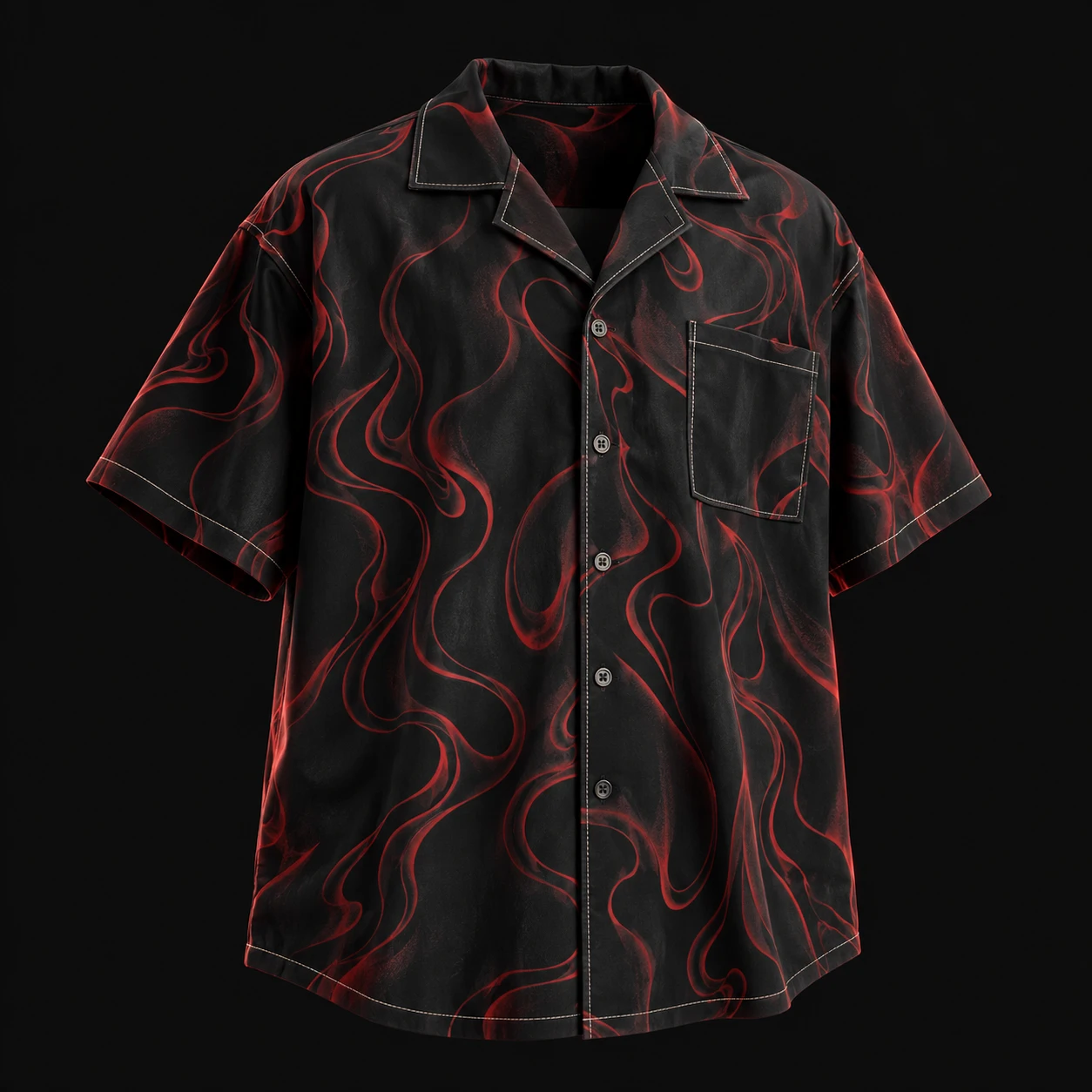
Separate the sewing question from the print question
For a UK label developing an adult printed button-up, the print proof and the sewn sample answer different questions. A repeat can be positioned correctly while the seam running through it looks rippled. Conversely, an accurately sewn seam may interrupt a motif because the artwork was never designed to match there. Mark these as separate comments so a sewing correction does not quietly change an approved print layout.
Our recommendation is to start with a seam map: front opening, shoulder, sleeve attachment, side seam and hem. Mark the precise location that needs review, then photograph the full shirt as well as the detail. Say whether the concern is a raised ridge, repeated ripples, uneven layers or displaced artwork. A clear observation is more useful than a remote guess at the machine setting.
Why one visible wrinkle does not identify one cause
Coats describes several contributors to seam puckering, including fabric structure, thread and needle selection, seam construction and uneven feeding. It also explains that different dimensional responses during washing or finishing can distort a seam. Several causes may act together. Its guidance supports a technical investigation of the actual material combination, rather than automatically blaming the thread.
AMANN explains tension puckering as fabric compression after stitch formation associated with excessive thread tension, and discusses thread balance and thread quantity. This is one possible mechanism, not a diagnosis of a shirt seen online. Ask the sewing team to record what it investigated and which trial changed the result; the buyer should approve the resulting garment rather than specify an unexplained tension number.
Identify the sample state before comparing submissions
Label each submission with style, colourway, fabric and print reference, sample size, revision and completed finishing stages. Note whether the shirt has just been pressed, has rested since pressing, or has already been washed. Keep those states distinct in the review file. The proposed record is a buying-team control, not a substitute for a laboratory method.
Retain an untouched reference where practical and agree which separate sample will undergo care review. Ask for the washing and drying procedure to be recorded, including the number of repetitions, rather than using the ambiguous note washed once. Compare the same locations in the submitted and evaluated states. Do not describe a household trial or a visual inspection as a certified test.
Compare sewn trials without losing the design
Request clearly identified trials when the production team proposes a correction. Keep the artwork revision, fabric identity and relevant seam location visible in each trial record. Ask the team to explain which construction or processing variables changed. If several variables had to change together, record the combination instead of attributing the improvement to one unproven cause.
Groz-Beckert cautions that general recommendations do not resolve every specific sewing problem, including different types of seam puckering. For the buyer, this supports asking for application-specific review when a repeat problem remains. It does not establish that a particular machine, needle or external technical service is used by Kylie.
After a revised seam is accepted, revisit its relationship with the design: priority motifs, stripe direction, front overlap and the intended garment shape. Ask whether the revision affects another visible seam or the approved measurements. A neater close-up is not enough if the whole shirt now differs from the agreed silhouette.
Sources: Groz-Beckert
Use an appearance review with a clear boundary
Our suggested review uses a consistent background, lighting and presentation agreed between buyer and supplier. View the shirt laid naturally and in the intended wearing position; do not pull the fabric taut to make the seam look smoother. Record both the face and reverse where accessible. Use photographs to locate concerns, with physical samples retained for the final appearance decision.
Keep seam appearance separate from strength, seam opening and fabric damage. This guide supplies no universal pass grade, stitch density, force threshold or UK regulatory requirement. If a measured test or a formal appearance assessment is needed, ask the technical team or laboratory to identify a suitable method and agree the acceptance criteria before testing.
A seam-by-seam approval worksheet
Use the following original worksheet for each seam under review. Give every revised trial a new identifier and keep the rejected and accepted observations distinguishable. Complete the record with the supplier rather than relying on a message saying make all stitching better.
- Identity: style, size, colourway, fabric and print references, sample revision and submission date.
- Location: seam name, marked start and end points, face or reverse, and annotated overview and detail photographs.
- State: finishing completed, pressing status, care procedure and evaluation date; identify the unwashed reference separately.
- Observation: what is visible, where it starts, and whether it changes after the agreed care review.
- Trial: proposed technical investigation, variables changed and the resulting sample identity; avoid an unsupported single-cause conclusion.
- Design check: approved motif relationships, dimensions and silhouette remain represented, or the change is explicitly resubmitted.
- Decision: accepted reference, unresolved locations, corrections required, reviewer and conditions requiring another sample.
Turn the accepted trial into the bulk reference
Keep the final accepted physical sample with its seam map and written decision. Identify any locations still on hold; approval of the side seam should not imply acceptance of an unresolved front opening. Agree which material, thread, construction or finishing substitutions would require renewed review before production.
For a Kylie Industry enquiry, send the original artwork, intended UK market, shirt shape, proposed material and marked seam photographs. Ask for a sampling discussion that separates print alignment from sewing appearance and includes the intended care review. Confirm the available construction options, quantities, costs and timing for the actual project. This checklist makes no claim that Kylie has tested a particular fabric or guarantees a specific result.
Continue your brief
Research and sources
This guide combines published source material with practical specification recommendations. It is not a physical test of the products mentioned. Product examples are references, not endorsements or affiliations.
- Eliminating Seam Puckering — Coats. Checked 2026-10-31.
- Tension puckering — AMANN. Checked 2026-10-31.
- Sewing problems and how to solve them — Groz-Beckert. Checked 2026-10-31.