
Define what the hem adjustment should do
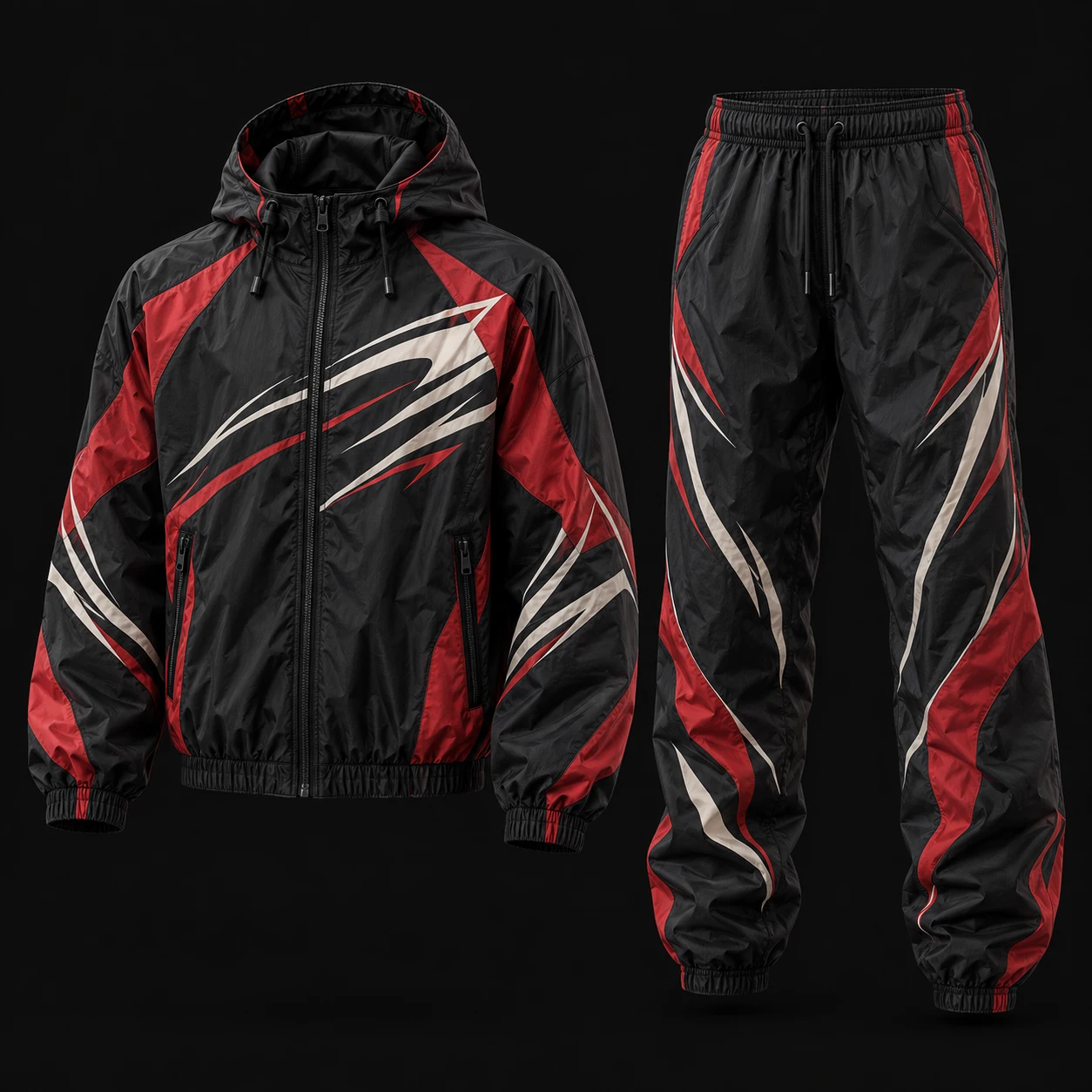
For a Canadian brand developing an adult windbreaker set, first describe the intended hem shape with the adjustment relaxed and drawn in. Mark whether the jacket has one adjustment point, a pair of side adjustments or another proposed layout. Keep jacket and trouser details separate when the set uses different systems.
H&M's Canadian windbreaker page describes an elasticized hem drawstring with cord stoppers. This is a current product-design observation, not evidence of growing demand or proof of how a Kylie garment is constructed. Use a reference image to communicate the intended appearance, then prepare your own cord-routing and trim record.
Sources: H&M Canada
Identify the cord and the exact stopper
Record the proposed cord reference, material description, elastic or non-elastic construction, shape and stated dimensions. Keep a physical length of the actual cord with the trim submission. Ask the supplier to identify which cord specification the proposed stopper is intended to accept, including the number of strands passing through it.
YKK describes its LE03SV as a single cord-end stopper used with a bungee cord and suitable as an outerwear adjuster. Its product record identifies the material and a size code. This illustrates why the complete part identity matters: a cord-end mechanism should not be substituted merely because another small plastic part looks similar.
Our recommendation is to retain the hardware reference, drawing or data sheet and a labelled sample together. Do not interpret an unexplained size code as a measured cord diameter. Confirm the intended pairing with the component supplier rather than assuming that all cords of a nominal size behave identically.
Sources: YKK Europe
Choose the operating layout deliberately
Duraflex's catalogue distinguishes different cord-lock mechanisms and cord configurations. Its Pop-Lock description uses a side-release arrangement, while other listed designs include an attachment loop for fixation. These examples show that operating method and mounting arrangement are separate selection details; they are not interchangeable promises of performance for every jacket.
Ask the sample maker to show where the wearer holds the assembly, how the cord moves and how the setting is released. Identify whether the hardware is intended to move freely or remain fixed at a defined point. Confirm the design in the actual garment before calling it one-handed or easy to use.
A catalogue feature belongs to the specified component under its stated conditions. It does not prove that a different cord, a changed routing path or an altered mounting point will work the same way. Record each proposed substitution as a new combination requiring review.
Sources: Duraflex USA
Map routing, exits and attachment
Our suggested routing sketch shows the cord channel, exits, stopper position, fixed ends and any retained loop or cord end. Mark the relaxed and adjusted positions on the same drawing. Identify where the cord passes close to pockets, the front opening, lining or other parts of the set.
Coats describes pre-production technical checks as a way to establish appropriate seaming conditions for a particular end use. That supports asking the sewing team to review the proposed attachment in the actual shell construction. It does not establish which reinforcement, thread or machine Kylie uses, or prescribe a universal stitch pattern.
Request an identified sewn trial when an attachment or exit detail is unresolved. Note any distortion, damaged material, loose attachment or restricted movement by location, then ask the technical team to investigate. A component-only approval should not quietly approve its connection to the garment.
Sources: Coats
Review operation on the sewn adult sample
Use the intended sample size and identified clothing layers for the review. Start with the hem relaxed, adjust it to the proposed wearing shape, then release it again. Record whether the wearer can locate and operate the intended control without pulling another garment component out of position. This is a proposed practical review, not a laboratory method.
Compare the two sides where the design uses paired controls. Look at the hem shape, accessible cord, hardware position and relationship with the pockets. If the design is intended to be used with gloves, include the specified gloves in that review instead of assuming bare-hand operation proves the same result.
Agree any repeated-operation, retention or after-care evaluation with the supplier or a competent laboratory before testing. Record the actual procedure and criteria. This article supplies no universal cycle count, holding force or acceptable adjustment range, and makes no claim that a Kylie assembly has passed a test.
Use a cord-adjuster approval record
Keep the following original worksheet with each sample revision. It makes the proposed combination traceable and separates appearance from operation. Use explicit decisions for unresolved details rather than a single message approving all trims.
- Design identity: adult jacket or trouser style, size, colourway and sample revision.
- Cord identity: supplier reference, construction, dimensions and retained physical sample.
- Hardware identity: exact part reference, material description, intended cord configuration and data-sheet revision.
- Layout: channel, exits, fixed points, stopper location and relaxed/adjusted positions.
- Evaluation: wearing layers, operating routine, observed movement or distortion, and any agreed care or technical test record.
- Decision: accepted combination, retained sample, unresolved items, reviewer and changes requiring renewed approval.
Close the trim decision with the sample
Keep the accepted cord and hardware combination attached to the identified garment reference. If the cord, stopper, routing or sewn attachment changes later, ask which checks need repeating. Approval of the hem adjustment does not close separate questions about fit, lining, zip function or material protection.
Send Kylie Industry the intended Canadian market, adult garment sketch, desired relaxed and adjusted hem appearance, trim references and routing notes. Ask which options and sampling arrangements can be provided, and confirm quantities, costs and timing for the actual project. This guide does not promise a particular branded component, manufacturing specification or protective performance.
Continue your brief
Research and sources
This guide combines published source material with practical specification recommendations. It is not a physical test of the products mentioned. Product examples are references, not endorsements or affiliations.
- LE03SV cord-end stopper — YKK Europe. Checked 2026-11-01.
- Duraflex USA catalogue — cord locks and pop locks — Duraflex USA. Checked 2026-11-01.
- Problem Solving — pre-production checks — Coats. Checked 2026-11-01.
- Water-Repellent Windbreaker — H&M Canada — H&M Canada. Checked 2026-11-01.