What does mesh lined actually cover?
Independent Trading Company’s EXP54LWZ product page identifies a fine mesh hood liner and mesh pocket bags. Those are named locations. They do not establish that its body and sleeves use the same construction. A buyer should avoid turning a specific component description into an assumption about the whole garment.
For a US clothing brand commissioning a jacket, our recommendation is to draw an inside view alongside the exterior design. Mark each lined and unlined area explicitly. If the supplier proposes different materials for the body and sleeves, record both. Leave an undecided area marked as pending instead of allowing a sample maker to interpret a general phrase.
Sources: Independent Trading Company
Use a lining map for the jacket and matching trousers
Build a small schedule with one row for each area below. In each row, enter the material reference, color, coverage boundary, attachment points and approval status. Ask the sample maker to show how adjacent areas meet. This is our proposed briefing tool, not a statement that every windbreaker needs a full lining.
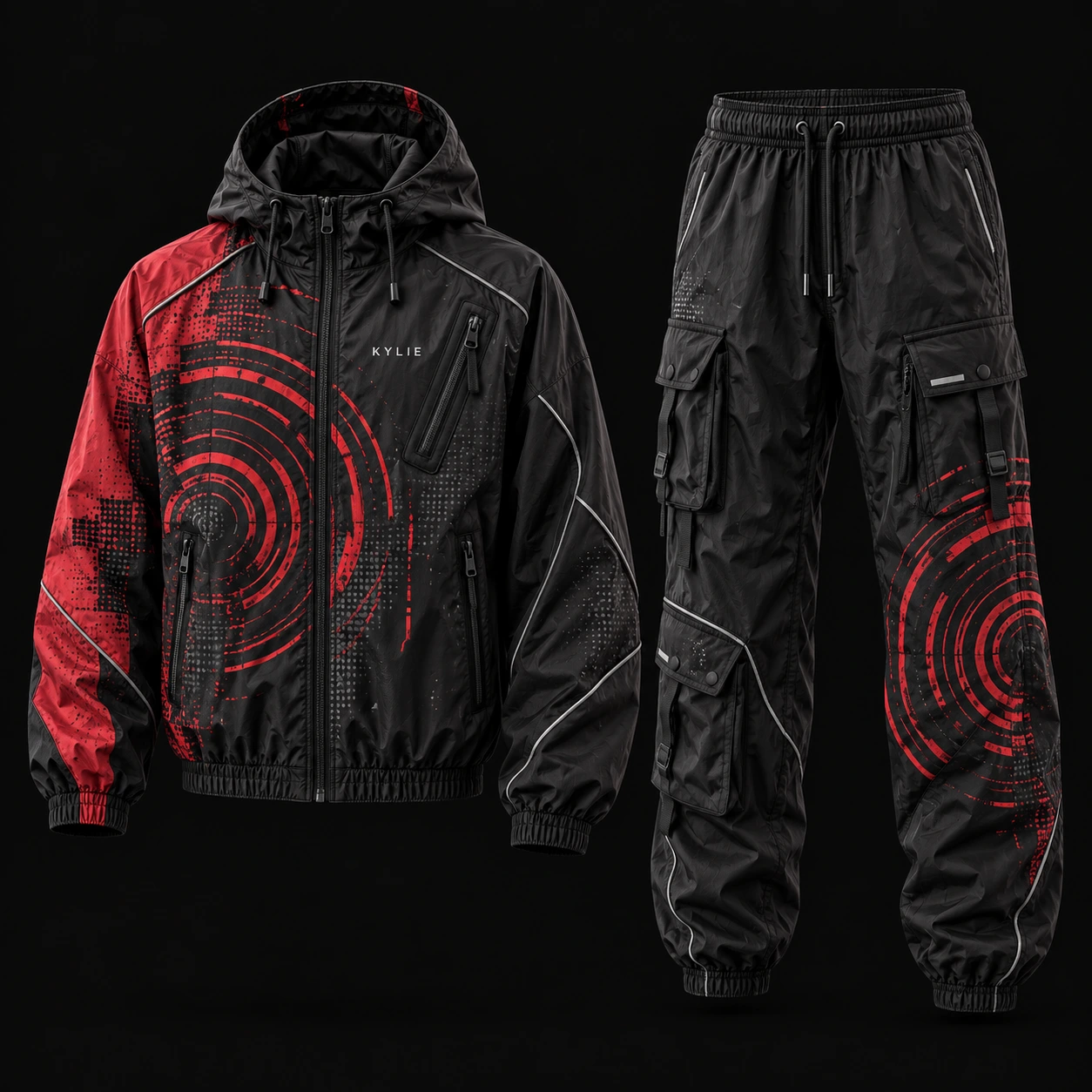
For a coordinated set, keep separate jacket and trouser maps. A matching exterior graphic does not specify matching interiors. Decide where lining is wanted in the trousers and where it should end, then assess the outfit together without copying the jacket’s construction into every panel.
- Hood: record whether there is a lining, which panels it covers and how its edge meets the outer fabric around the face opening.
- Body: identify front and back coverage, including any partial lining boundary. Mark the relationship to the hem and front opening.
- Sleeves: specify the material and coverage independently; identify the attachment at the cuff and the junction with the body.
- Pocket bags: record their material and shape separately from the body lining. Show any internal pockets and their attachment.
- Decoration areas: mark the proposed inside access route and the intended appearance behind each logo or graphic.
Plan decoration access before approving the interior
AS Colour’s US Cyrus Windbreaker page lists an invisible lining access zipper intended to assist branding. That is a concrete example of an access feature being included in the garment specification. It does not mean an access zipper is required for every custom jacket or that it will reach every planned design position.
Our recommendation is to ask the decorator and sample maker to agree the sequence before the lining is finalized. Will the artwork be applied to a panel before assembly, or to the assembled garment? Which layers are intended to receive stitches or contact the decoration equipment? Mark those decisions for the chest, back and sleeves individually.
For example, a hypothetical jacket with a small chest emblem and a large sleeve design may need two different access arrangements. Ask for a sample demonstration at both positions. Record how any access opening is closed afterward and what the customer should see inside. Avoid approving only the front-facing artwork photograph.
Sources: AS Colour
Review movement and the finished interior together
We recommend checking the completed sample over the layers intended for the collection. For a US urban capsule, that might mean reviewing it over a T-shirt and again over the actual sweatshirt selected for the outfit. These are proposed wearing scenarios, not claims about one national climate or customer preference.
Put the garment on and remove it, bend the elbows, reach forward and use the pockets. Note any point where the interior catches, pulls or appears outside the intended edge. Photograph that location with the garment configuration recorded. Ask the sample maker to investigate the pattern, attachment and material combination rather than assuming that more lining or a larger shell will solve it.
Also review the inside while the garment is hanging and laid flat. Check the visible seam finish, access closure, labels and junctions between different materials. Record deliberate design features separately from unwanted exposed edges. A neat exterior photograph cannot answer all of these interior questions.
Check appearance again after the agreed care procedure
American & Efird’s technical bulletin explains that seam puckering can have several causes, including thread tension, uneven feeding of fabric layers and different shrinkage among seam components. Its guidance supports investigating the assembled combination; a gathered seam is not enough to identify one faulty material.
For lining approval, we recommend retaining an unchanged reference and reviewing another completed sample after the care procedure agreed for the project. Record the procedure and the observed changes at the hem, cuffs, hood edge and decoration areas. Have the production team investigate any new pulling or gathering before revising the specification.
This is a development review, not a standardized performance test. It does not establish water protection, breathability or service life. If any of those claims are planned, agree the evidence separately; the linked water-protection guide explains that distinction.
Sources: American & Efird
Close the brief with a clear approval record
Our suggested approval record contains the lining map, identified material references, decoration sequence, photographs of the finished inside and any agreed care observations. Give unresolved items an owner and a next action. A change to a lining material, coverage boundary or access arrangement should be reviewed against the approved sample before production proceeds.
Keep the choice tied to the product you intend to sell: its silhouette, wearing layers, artwork and desired interior appearance. Avoid promising that mesh automatically makes every jacket comfortable, or that a more extensive lining is always a better specification. The useful outcome is a shared, reviewable design decision.
To discuss a windbreaker set with Kylie Industry, send your exterior artwork, target US customer, intended layers and a marked inside view. Use the enquiry link below to ask which lining, decoration and sampling options can be confirmed for the project. This guide does not establish Kylie material availability, order quantities, costs or delivery timing.
Continue your brief
Research and sources
This guide combines published source material with practical specification recommendations. It is not a physical test of the products mentioned. Product examples are references, not endorsements or affiliations.
- EXP54LWZ Lightweight Windbreaker Jacket — Independent Trading Company. Checked 2026-10-16.
- Cyrus Windbreaker 5501 — AS Colour. Checked 2026-10-16.
- Minimizing Seam Puckering — American & Efird. Checked 2026-10-16.