
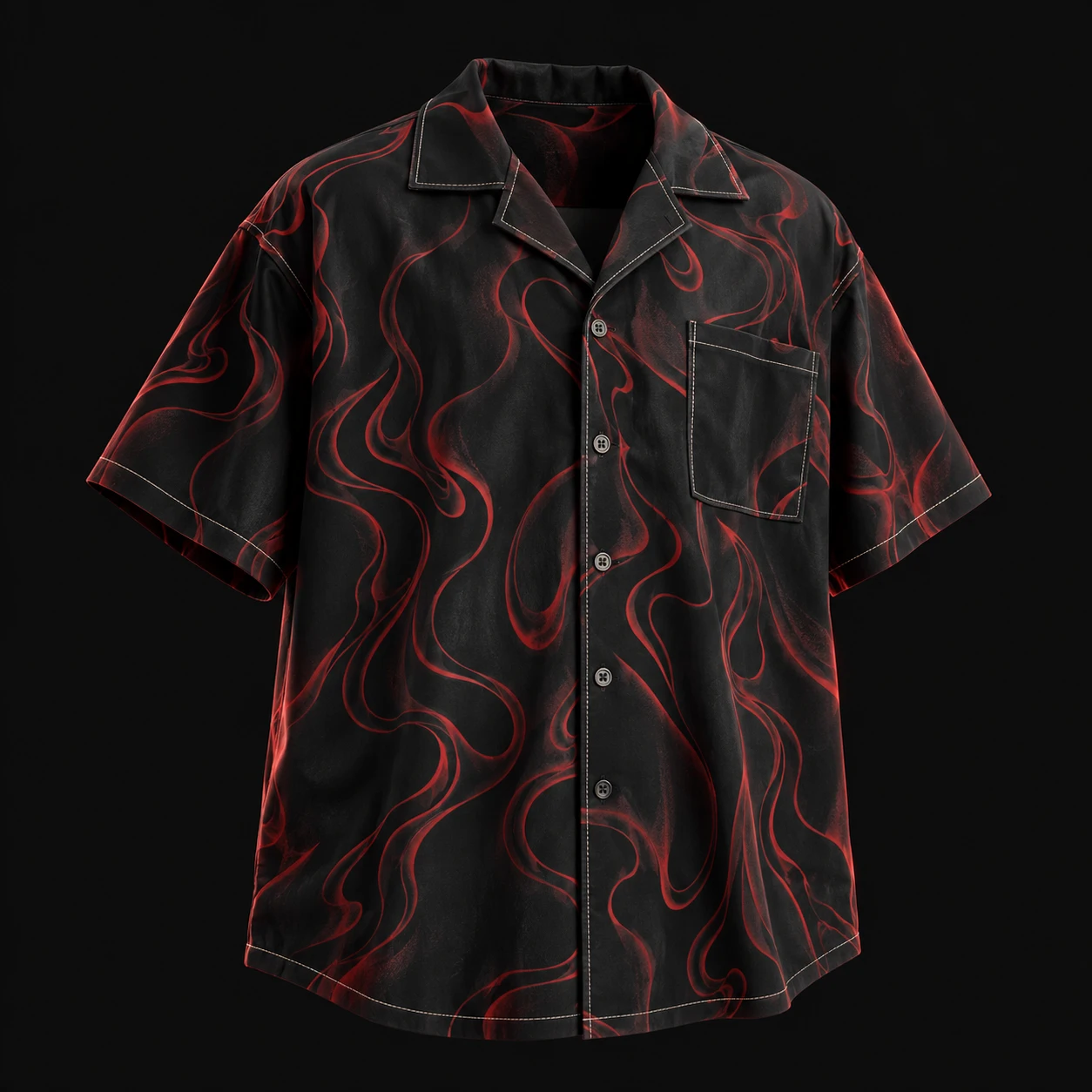
Start with the inside appearance you want
For a UK streetwear label developing a printed woven shirt, the reverse can matter when the garment is worn open or a sleeve is turned back. Decide which inside edges will be visible and what you want the buyer to see there. Mark the particular side seam or sleeve seam on a drawing instead of adding an instruction that every seam must look premium.
Our recommendation is to request one clearly identified construction trial before making a garment-wide decision. Use the proposed printed cloth and show its face and reverse. Keep the artwork reference attached to the trial so the reviewer can judge whether a visible fold interrupts an important motif. This article discusses a construction option to enquire about, not a promise that a particular Kylie shirt already uses it.
Make a drawing carry the seam definition
Coats distinguishes seam construction from stitch selection and says a meaningful seam specification also identifies the stitch type. Its guide describes edge neatening separately from joining layers. These distinctions help a buyer ask what the proposed operation actually does, rather than treating any tidy thread-covered edge as the same construction.
American & Efird provides a seam drawing chart that labels French seaming as SSae. Use that drawing as a discussion reference with the sewing team, not as proof of a performance level. Ask them to confirm the cross-section they propose and the corresponding stitch information. A labelled section view is especially useful when different parties use a familiar seam name in different ways.
Sources: Coats Group · American & Efird
Consider fabric and seam shape before choosing
Seamwork describes a French seam as enclosing the cut edges through a second sewing stage. Its practical guidance favours this approach for lightweight fabrics and notes that straight or gently curved seams are easier candidates than tight curves and corners. That is a useful starting point for a trial, not a universal specification for every printed shirt.
We suggest selecting a representative straight section and the most awkward nearby transition. Ask whether the proposed fabric, fold and finished width can follow the design at both locations. Handle the sewn example as well as looking at it. Do not approve an entire armhole merely because a short straight demonstration looks clean; agree a separate trial if the construction changes around that curve.
Sources: Seamwork
Keep a junction in the construction trial
For the buyer review, request a trial that includes the intended hem or side-slit ending rather than stopping the sample before it. Photograph the inside and outside with the ending clearly labelled. Ask the sewing team to show where the enclosed edge terminates and how any remaining cut edge is finished. Record which detail has been accepted at that junction.
Our proposed comparison uses two identified alternatives if the supplier can provide them: an enclosed seam and the supplier’s suggested joined-and-neatened construction. Keep the cloth, print revision and reviewed location comparable. Note the differences you can observe in thickness, visible stitching, flexibility and appearance at the ending. These observations help choose a design; they are not laboratory measurements or a claim that one option is always stronger.
Use a construction card with five decisions
The following original construction card is intended for the buyer and supplier to complete together. It links the definition of the fold to an actual garment location, so a good straight trial cannot silently approve every junction. Leave a field open when the required sample or technical answer has not been supplied.
- Identity: fabric and print reference, garment revision, sample identifier and exact seam location.
- Section: agreed layer arrangement, location of enclosed edges, finished width and stitch information confirmed by the sewing team.
- Transition: hem, slit or intersecting seam included in the trial, with inside and outside photographs.
- Review: accepted appearance and handling observations, unresolved points and any separately agreed care assessment.
- Decision: retained physical reference, reviewer, approval date and changes that require renewed review.
Do not turn an enclosed edge into a test result
A hypothetical trial might have an attractive enclosed side seam but an unresolved slit ending. Accepting the first observation should leave the second decision open. Ask for a revised ending and retain its identifier alongside the straight-section reference. If the cloth or construction later changes, ask which earlier approvals still represent the proposal.
Keep any required strength or durability evidence separate from the visual construction card. Agree the relevant evaluation and acceptance criteria with the technical team before commissioning it. This guide specifies no seam allowance, stitch density, pass force or care-cycle target. It reports no physical testing and makes no claim about UK legal compliance.
Send a specific shirt-construction enquiry
Send Kylie Industry your printed woven shirt drawing, intended UK market, artwork file and the locations where an enclosed inside finish matters. Include the cross-section reference and ask which construction and junction samples can be discussed. Confirm the offered materials, costs, quantities and sampling schedule for that project rather than assuming a particular process is available.
Retain the chosen trial with the approved garment brief. Refer separately to the artwork-layout decision and to any seam-appearance corrections: choosing an enclosed edge does not resolve print placement or diagnose puckering. The useful outcome is a construction the buyer and supplier can identify in the same way, with its remaining questions visible before production.
Continue your brief
Research and sources
This guide combines published source material with practical specification recommendations. It is not a physical test of the products mentioned. Product examples are references, not endorsements or affiliations.
- Seam Types — Coats Group. Checked 2026-11-08.
- Seams Drawings — American & Efird. Checked 2026-11-08.
- How to Choose the Perfect Seam Finish for Any Project — Seamwork. Checked 2026-11-08.