
Separate three questions before choosing a fabric
Air permeability describes air passing through a textile. ISO 9237 identifies a method for measuring this property. Moisture-vapour movement is a different question: ISO 11092:2026 covers thermal and water-vapour resistance under steady-state conditions, including multilayer materials. An airflow result cannot stand in for a water-vapour resistance result.
Gore illustrates why the distinction matters. Its technical account describes materials engineered for wind protection while allowing water vapour to escape. That is an example of separate properties being designed together, not evidence that every windbreaker offers both or that Kylie uses those materials.
For development, give garment ventilation its own field: the openings a wearer can use, such as an agreed front-opening position or purpose-designed vent. Our recommendation is to review those openings on the complete sample. Opening a zip during a fitting does not measure the fabric’s permeability.
Sources: ISO · ISO · GORE-TEX Professional
What current collections can—and cannot—tell a buyer
Represent’s 247 FW26 Drop 2 page announces an October 7 online release and includes a Trail Windbreaker in its outdoor-training layers. More Money More Love’s October 4 collection lists a plaid windbreaker within a broader fashion lineup. These are two recent, independent collection observations, showing different ways to position this garment.
Neither page establishes growing European demand or a performance requirement for your brand. For a collection intended for customers in Germany or France, write a specific wearing scenario: for example, walking between indoor stops or an active outdoor session. Those are proposed scenarios to investigate with your customers, not assumptions about everyone in either country.
Choose the priority before discussing fabric numbers. Is the brief about reducing felt wind during a short outing, allowing moisture to escape during activity, or giving the wearer adjustable openings? More than one can matter, but each needs a separate question and supporting evidence.
Sources: Represent · More Money More Love
Ask for evidence from the actual proposed material
Our recommended supplier request starts with the material reference and the layers being assessed. Identify the outer fabric, any coating or membrane, and any backing included in the specimen. Keep a separate record of the garment lining. A report should make clear whether it concerns one material or an assembly.
Hohenstein’s breathability factsheet describes measuring material-specific water-vapour resistance with its skin model. It also states that measurements can concern new material, material after washing or cleaning, or both, according to the customer specification. That makes sample condition an important field in your comparison.
Ask for the laboratory, report date, specimen identity, method and edition, result, units and conditioning or care history. Request an explanation of differences before ranking two reports. If one quotation contains only the adjective breathable, record the evidence as pending rather than treating it as equivalent to a measured result.
Sources: Hohenstein
Use this three-part buying worksheet
The following is our suggested decision sheet. Complete all three rows for each candidate material and garment design. Record the question, evidence received, unresolved item and next action. It is a briefing tool, not a scoring system or an acceptance standard.
- Air passage through fabric: identify the proposed material and request the appropriate air-permeability evidence. Ask the testing provider to specify the method, settings, units and acceptance criteria for the intended use; leave approval open until those are agreed.
- Moisture-vapour performance: identify whether the evidence covers the relevant material or multilayer assembly, and whether it is new or after care. Keep this result in its own column rather than combining it with an airflow number.
- Wearer-controlled ventilation: mark each intended opening on a drawing, its closed and open positions, and how the wearer reaches it. Review the assembled jacket and trousers separately, with the planned layers underneath.
Compare comfort observations without turning them into ratings
ISO 11092:2026 explicitly says its test conditions are not intended to represent specific comfort situations, and it does not state physiological-comfort performance specifications. A material report is therefore one input to development; it does not settle how every wearer will feel in the finished outfit.
Our recommendation is to compare prototypes under a documented, repeatable wearing scenario. Record the person, underlying layers, activity, duration, surroundings and opening positions. Note perceived warmth, dampness and where the wearer wanted an adjustment. Keep those observations clearly labelled as subjective development feedback, separate from laboratory results.
Consider a hypothetical buyer comparing two jackets. One feels more comfortable during a walk, but it was worn with the front partly open and over a lighter tee. The next useful step is to repeat the comparison with the same layers and opening configuration. That first observation cannot identify which fabric has better water-vapour performance.
For a matching set, record jacket and trouser feedback independently. Do not extend a report for one shell material to a second material simply because the colours match. Ask the supplier or laboratory which configuration should be assessed when the proposed construction changes.
Sources: ISO
Close the material decision and the product wording together
Our proposed release record contains the selected material references, applicable reports, agreed ventilation drawing and completed sample observations. Record which changes would reopen the decision, such as a replacement coating, backing or fabric. Ask the testing provider whether revised evidence is needed rather than assuming the original report follows every substitute.
Keep rain-protection wording separate; the linked water-resistance guide covers that evidence. Likewise, use the lining guide for coverage and decoration access. Those decisions interact in the finished design, but approving one does not automatically approve the others.
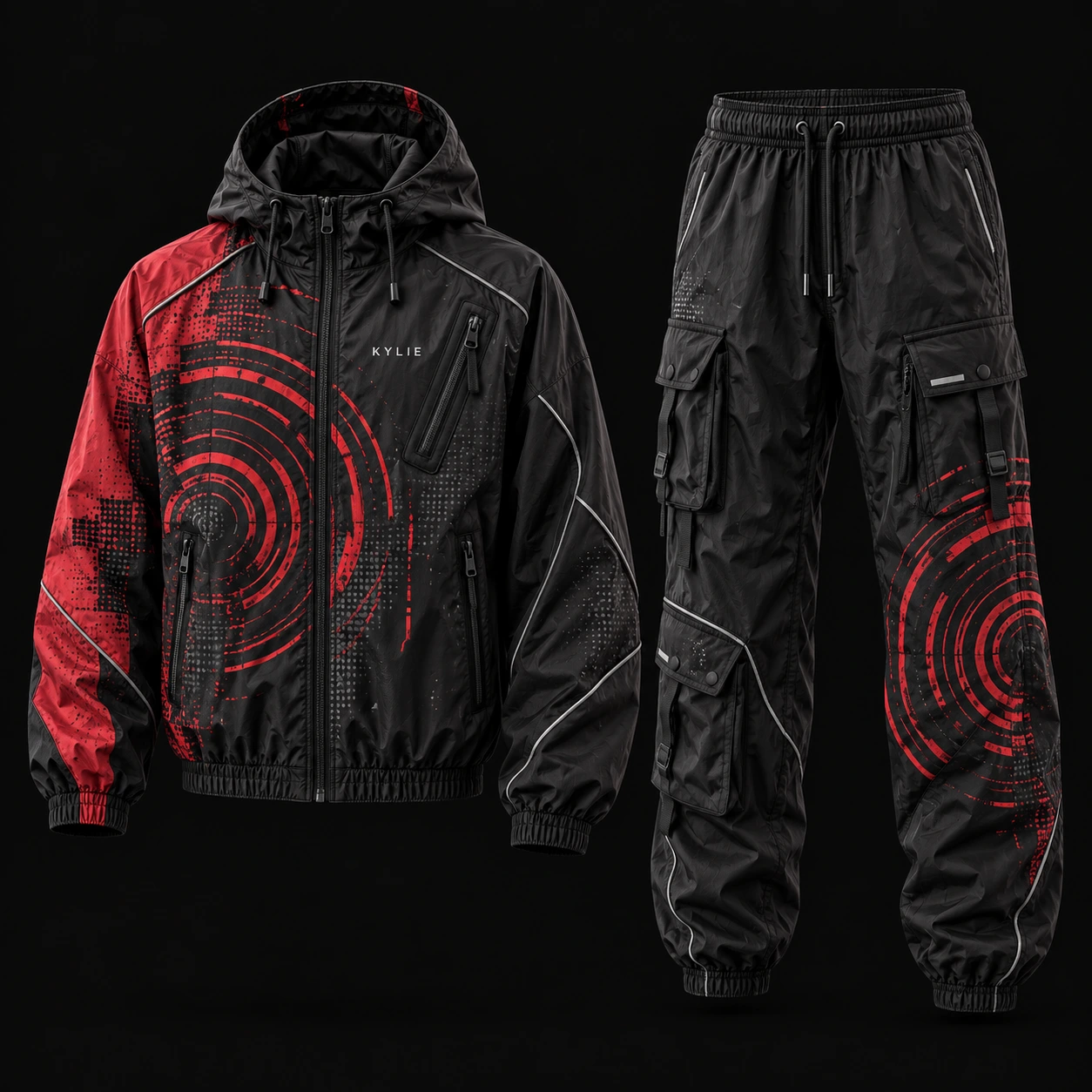
To discuss a windbreaker set with Kylie Industry, send your target countries, wearing scenario, design references and completed three-part worksheet through the enquiry link below. Ask which material options, sampling arrangements and testing support can be confirmed for your project. The illustration is a design reference, and this guide makes no claim that a Kylie garment has undergone these tests.
Continue your brief
Research and sources
This guide combines published source material with practical specification recommendations. It is not a physical test of the products mentioned. Product examples are references, not endorsements or affiliations.
- ISO 9237:1995 — Permeability of fabrics to air — ISO. Checked 2026-10-24.
- ISO 11092:2026 — Thermal and water-vapour resistance — ISO. Checked 2026-10-24.
- Factsheet — Breathability — Hohenstein. Checked 2026-10-24.
- Science of Protection — GORE-TEX Professional. Checked 2026-10-24.
- 247 FW26 Story Continues — Represent. Checked 2026-10-24.
- Fall Winter 02 Drop — More Money More Love. Checked 2026-10-24.